


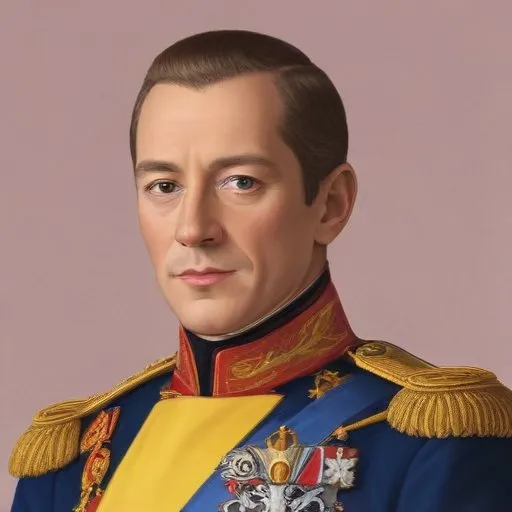
King of Sweden and Norway from 1859 to 1872, known for his liberal reforms and modernization of the Swedish military.
Charles XV of Sweden, also known as Carl XV, was the King of Sweden and Norway from 1859 until his death in 1872. He is most famously known for his cultural and artistic contributions, earning him the nickname "The King of Renaissance."
During his reign, Charles XV was a strong supporter of the arts, literature, and culture. He was a patron of numerous artists, writers, and musicians, and his court became a hub for creative expression. His love for the arts led to the establishment of several cultural institutions, including the Royal Swedish Opera and the Royal Dramatic Theatre.
One of his most notable contributions was the development of the Swedish language and literature. He encouraged the use of Swedish as a literary language, which led to a resurgence of Swedish literature and poetry.
Charles XV was also a skilled military leader, and his reign saw several significant military reforms. He introduced conscription, modernized the army, and established a naval academy.
Despite his military prowess, Charles XV was a strong advocate for peace and diplomacy. He played a crucial role in maintaining Sweden's neutrality during the Danish-Prussian War and the Franco-Prussian War.
Charles XV's personal life was marked by passion and romance. He was known for his numerous affairs, including one with the Swedish actress and singer, Hanna Styrell.
He was also an avid traveler and explorer, and his journeys took him to various parts of Europe and the Middle East. His love for adventure and discovery led to the establishment of the Royal Swedish Geographical Society.
Charles XV's legacy is still felt in Sweden today. His contributions to the arts, literature, and culture have had a lasting impact on Swedish society. He is remembered as a king who brought about a cultural renaissance in Sweden.
His military reforms and diplomatic efforts helped maintain Sweden's neutrality and stability during a tumultuous period in European history.
"Art is the expression of the soul, and the soul of a nation is reflected in its art."
Charles XV's reign took place during a time of great change and upheaval in Europe. The Industrial Revolution was transforming the continent, and nationalism was on the rise. Despite these challenges, Charles XV's focus on culture and diplomacy helped Sweden maintain its independence and neutrality.
His legacy continues to inspire Swedish artists, writers, and musicians to this day.
Charles XV's relationships with his family members were often marked by tension and conflict. His marriage to Louise of the Netherlands was troubled, and the couple had only one son, Carl Oscar.
Anecdotes about Charles XV's life reveal a charismatic and passionate individual. One famous story tells of him arriving unannounced at a Stockholm theatre performance, where he was so moved by the play that he joined the cast on stage.
Born in 1829
King of Sweden and Norway from 1872 to 1907, known for his diplomatic efforts to maintain Scandinavian unity and neutrality during the tumultuous late 19th century.
Born in 1829
King of Sweden and Norway from 1872 to 1907, known for his diplomatic efforts to maintain Scandinavian unity and neutrality during the tumultuous late 19th century.
Born in 1496
Led a successful rebellion against Danish rule, establishing Sweden as an independent nation and laying the groundwork for its future prosperity.
Born in 1872
The first king of Norway after the country's independence from Sweden, he played a crucial role in maintaining Norway's sovereignty during World War II. He's revered for his bravery and leadership during the war.
Born in 1609
King of Denmark and Norway from 1648 to 1670, known for establishing absolute monarchy and modernizing Denmark's administration.
Born in 1818
The King of Denmark who unified the country and founded the modern Danish monarchy, known for his strong leadership and family ties to European royal houses.
Born in 1822
Developed vaccines for rabies and anthrax, and pioneered the germ theory of disease, revolutionizing our understanding of microbiology and disease prevention.
Born in 1820
Pioneering nurse and statistician who revolutionized healthcare by introducing sanitation practices and data-driven decision making, becoming the founder of modern nursing.
