


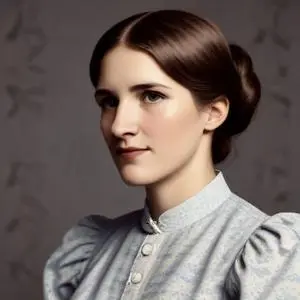
Pioneering feminist writer and social reformer who penned the iconic short story "The Yellow Wallpaper," a powerful critique of patriarchal society and the oppression of women.
Charlotte Perkins Gilman, a renowned American writer, lecturer, and advocate for social reform, is best known for her groundbreaking short story "The Yellow Wallpaper," a semi-autobiographical tale that exposed the dark realities of postpartum depression and the restrictive societal norms imposed on women during the late 19th century. As a utopian feminist, Gilman dedicated her life to challenging the status quo, promoting gender equality, and inspiring future generations of feminists.
Gilman was born on July 3, 1860, in Hartford, Connecticut, to Mary Fitch Westcott and Frederic Beecher Perkins. Her childhood was marked by poverty and family struggles, with her father abandoning the family when she was just a toddler. Despite these challenging circumstances, Gilman was surrounded by strong, independent women, including her aunts, Isabella Beecher Hooker, a suffragist, and Harriet Beecher Stowe, author of "Uncle Tom's Cabin."
Gilman's education was erratic, attending seven different schools for a total of only four years. Her mother, though well-intentioned, was not affectionate and discouraged her children from forming close relationships or reading fiction, fearing they would get hurt as she had. Ironically, this isolation and lack of emotional nourishment would later fuel Gilman's passion for social reform and her determination to challenge societal norms.
Gilman's literary career was marked by a range of influential works, including "The Yellow Wallpaper" (1892), "Women and Economics" (1898), and "Herland" (1915). Her writing often explored themes of gender, labor, and social reform, offering insightful commentary on the lives of women during the late 19th and early 20th centuries.
"The Yellow Wallpaper," in particular, has become a classic of American literature, offering a powerful portrayal of the devastating effects of postpartum depression and the restrictive patriarchal society that perpetuated it. The story, semi-autobiographical in nature, drew heavily from Gilman's own experiences with depression and her struggles to balance motherhood with her writing career.
Gilman's pioneering work has had a lasting impact on modern society, inspiring generations of feminists and social reformers. Her advocacy for women's rights, reproductive freedom, and social justice continues to resonate today, making her a revered figure in the struggle for gender equality.
In 1994, Gilman was posthumously inducted into the National Women's Hall of Fame, a testament to her enduring legacy and the significant contributions she made to the fight for women's rights and social reform.
Charlotte Perkins Gilman's life and work continue to inspire and educate, offering a powerful reminder of the importance of challenging societal norms and fighting for social justice. As a pioneering feminist and advocate for social reform, Gilman's influence extends far beyond her own time, shaping the course of modern feminism and continuing to inspire generations to come.
Through her writing, Gilman leaves behind a lasting testament to the power of the human spirit, a spirit that refused to be bound by the constraints of her time, and instead chose to challenge, inspire, and transform the world around her.
Born in 1878
A pioneering muckraker, exposing social and economic injustices through influential novels, most notably "The Jungle", which led to significant reforms in the meatpacking industry.
Born in 1855
A pioneering labor leader who fought for workers' rights and social justice, founding the Industrial Workers of the World and running for president five times on the Socialist Party ticket.
Born in 1860
A pioneering social worker and peace activist, she founded Hull House, a settlement that provided social services to immigrants and the working poor, and was awarded the Nobel Peace Prize in 1931.
Born in 1857
A pioneering investigative journalist who exposed corporate wrongdoing, particularly in the oil industry, through her meticulous research and writing, sparking significant reforms.
Born in 1820
Pioneering figure in the women's suffrage movement, fighting for women's right to vote and own property. Her tireless efforts led to significant advancements in women's rights.
Born in 1815
Pioneering women's rights activist who led the women's suffrage movement, fighting for women's right to vote and own property.
Born in 1885
A pioneering figure in the women's suffrage movement, fighting for equal rights and voting privileges through nonviolent protests and strategic lobbying. Her legacy continues to inspire feminist activism today.
Born in 1879
A pioneering birth control activist who advocated for women's reproductive rights and founded the American Birth Control League, precursor to Planned Parenthood.
