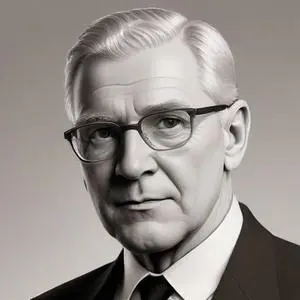
Chester Carlson: The Visionary Inventor of Xerography
The Birth of Electrophotography
Chester Carlson, a renowned American physicist and inventor, is best known for pioneering electrophotography, a technology that has revolutionized the way we reproduce documents. His groundbreaking invention, now commonly referred to as xerography, has enabled millions of photocopiers worldwide to produce high-quality copies with unprecedented speed and accuracy.
Early Life and Inspirations
Born on February 8, 1906, in Seattle, Washington, Carlson's early life was marked by adversity and a strong desire to overcome it. His father, Olaf Adolph Carlson, suffered from tuberculosis and arthritis, while his mother, Ellen, contracted malaria during a brief stint in Mexico. These health issues forced Carlson to take on various odd jobs from a tender age to support his family. Despite the challenges, he found solace in inventing and experimenting, drawing inspiration from iconic figures like Thomas Alva Edison.
Education and Career
Carlson's perseverance and fascination with science led him to pursue higher education. He graduated from California Institute of Technology (Caltech) in 1930 with a degree in physics. Subsequently, he worked as a patent attorney, where he honed his skills in the intricacies of intellectual property law. This expertise would later prove instrumental in his battle to patent his xerographic invention.
The Genesis of Xerography
In the 1930s, Carlson began experimenting with the principles of electrostatic charging and photoconductivity. He successfully created the first electrophotographic image in 1938, using a mixture of sulfur and selenium to create a light-sensitive drum. This pioneering work laid the foundation for modern photocopiers, which would go on to revolutionize the way documents were reproduced.
Patent Battles and Triumph
The road to commercializing xerography was not without its challenges. Carlson faced intense competition and skepticism from established industry players. However, his patent attorney background enabled him to navigate the complex legal landscape and secure crucial patents for his invention. In 1947, he finally licensed his technology to the Haloid Photographic Company, which would later become Xerox Corporation.
Philosophical Contributions and Beliefs
Carlson's ingenuity and perseverance serve as a testament to his strong work ethic and commitment to innovation. He believed that an individual's economic status could be transformed through invention and contribution to society. This philosophy is reflected in his own life, where he rose from poverty to become a celebrated inventor and entrepreneur.
Personal Milestones and Key Life Events
Carlson's personal life was marked by tragedy, including the loss of his mother at the age of 17 and his father at 27. Despite these challenges, he remained driven and focused on his goals. He married his wife, Doris, in 1934, and they had two daughters together.
Legacy and Impact on Modern Society
Chester Carlson's invention of xerography has had a profound impact on modern society. His technology has enabled rapid, high-quality document reproduction, transforming the way we work, communicate, and share information. Today, photocopiers are an ubiquitous part of our daily lives, with millions of machines operating worldwide.
Comparative Analysis with Contemporaries
Carlson's contributions to the field of physics and invention are often likened to those of his contemporaries, such as Edwin Land and Russell Varian. While their work focused on polarized light and klystron tubes, respectively, Carlson's electrophotographic invention stands as a testament to his unique genius and innovative spirit.
Inspirational Stories and Motivations
Carlson's life serves as a powerful motivator for aspiring inventors and entrepreneurs. His perseverance in the face of adversity, coupled with his passion for innovation, demonstrates that even the most seemingly insurmountable challenges can be overcome with determination and hard work.
Trivia and Fun Facts
- Carlson's first xerographic image was created using a sulfur-coated plate and a Selenium drum.
- He was awarded the National Medal of Science in 1966 for his contributions to the field of physics.
- Carlson's invention of xerography was initially met with skepticism by industry experts, who dubbed it "dry photography."
Legacy and Historical Context
Chester Carlson's legacy extends far beyond his invention of xerography. He embodies the spirit of innovation and perseverance, inspiring generations of inventors, entrepreneurs, and scientists. His contributions to the field of physics and his impact on modern society serve as a testament to the power of human ingenuity and creativity.