


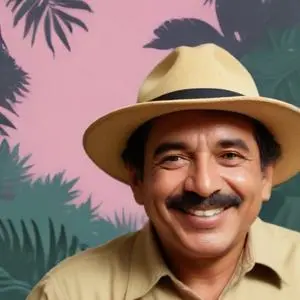
A Brazilian rubber tapper who fought to preserve the Amazon rainforest and protect the rights of indigenous people, ultimately giving his life for the cause.
Chico Mendes, a Brazilian rubber tapper, trade union leader, and environmentalist, is renowned for his unwavering dedication to preserving the Amazon rainforest and advocating for the human rights of Brazilian peasants and Indigenous peoples.
Born on December 15, 1944, in the rubber reserve of Seringal Bom Futuro, outside Xapuri, Acre, Chico Mendes was the son of a second-generation rubber tapper, Francisco Mendes, and his wife, Irac. He was one of 17 siblings, with only six surviving childhood.
At the age of 9, Chico began working as a rubber tapper alongside his father. The industry was in decline, and land was frequently sold and burned for cattle pastures. Rubber tappers faced a severe lack of education, and schools were often forbidden on and near plantations to prevent workers from learning to read and do arithmetic. Chico's desire to learn led him to seek out help interpreting his bills at the age of 18, and he was taught to read and write by Euclides Fernando Távora, an activist turned rubber tapper.
Mendes became a literacy teacher, educating his community and spreading awareness about social and political issues within Brazil. This newfound knowledge ignited his dissatisfaction with the treatment of seringueiros (rubber tappers) and fueled his determination to fight for their rights.
Chico Mendes' leadership and advocacy led to his election as president of the Rural Workers' Union of Xapuri in 1975. He continued to fight against the exploitation of rubber tappers, land grabbing, and environmental destruction. His activism earned him recognition, and he became a key figure in the Brazilian environmental movement.
Mendes' most significant battle was against the destruction of the Amazon rainforest. He faced off against ranchers, loggers, and corrupt politicians who sought to exploit the forest for personal gain. He organized protests, rallies, and boycotts, using non-violent resistance to raise awareness and pressure the government to take action.
On December 22, 1988, Chico Mendes was assassinated by a rancher, Darly Alves da Silva, who was later convicted of the crime. Mendes' death sparked international outrage and galvanized the environmental movement worldwide. The Chico Mendes Institute for Biodiversity Conservation (ICMBio) was established in his honor, and his legacy continues to inspire environmentalists, activists, and social justice advocates.
Chico Mendes' unwavering commitment to environmental and social justice has had a profound impact on modern society. His fight for the Amazon rainforest has inspired a new generation of environmentalists, and his legacy continues to influence policy and advocacy efforts worldwide.
Chico Mendes received several awards and honors for his work, including the Right Livelihood Award (1984) and the Global 500 Roll of Honor (1987). His posthumous recognition includes the Brazilian Order of Cultural Merit (1989) and the creation of the Chico Mendes Institute for Biodiversity Conservation (1990).
78 Years Old
Brazil's first female president, a key figure in the country's economic development and a symbol of female empowerment in Latin American politics.
85 Years Old
Brazil's 25th Vice President, a lawyer and politician, who took over as President after Dilma Rousseff's impeachment and implemented austerity measures to address the country's economic crisis. He's known for his controversial presidency and corruption charges.
71 Years Old
A far-right politician who served as President of Brazil from 2019 to 2023, known for his controversial views on the environment, indigenous rights, and LGBTQ+ issues. He's a polarizing figure who sparked intense debates and protests during his presidency.
68 Years Old
A pioneering environmentalist and politician who fought to preserve the Amazon rainforest and advocated for indigenous rights, becoming a powerful voice in Brazilian politics.
