


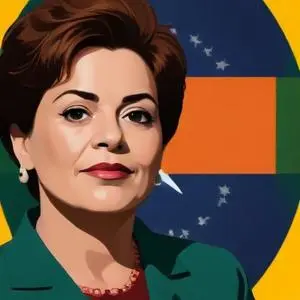
Brazil's first female president, a key figure in the country's economic development and a symbol of female empowerment in Latin American politics.
Dilma Rousseff is a Brazilian economist and politician who made history by becoming the first woman to hold the office of President of Brazil, serving from 2011 to 2016. She is known for her unwavering commitment to social and economic development, and her efforts to strengthen Brazil's economy and international relations.
Born on December 14, 1947, in Belo Horizonte, Brazil, Dilma Rousseff grew up in an upper-middle-class family. She developed an interest in socialism during her youth and became involved in left-wing and Marxist urban guerrilla groups that fought against the military dictatorship in Brazil.
Rousseff's political career began in the 1980s when she helped found the Democratic Labour Party (PDT) in Rio Grande do Sul. She served as the treasury secretary of Porto Alegre under Alceu Collares and later as Secretary of Energy of Rio Grande do Sul under both Collares and Olvio Dutra.
In 2001, she joined the Workers' Party (PT) and became an energy policy advisor to presidential candidate Luiz Inácio Lula da Silva. After Lula's election, she served as his Minister of Energy and later as Chief of Staff from 2005 to 2010.
Rousseff was elected as the 36th President of Brazil in 2010, winning a runoff election against José Serra. During her presidency, she implemented several social programs aimed at reducing poverty and inequality, such as the Bolsa Família program.
She also strengthened Brazil's economy by investing in infrastructure, promoting foreign trade, and increasing access to education and healthcare. Her administration also introduced policies to reduce carbon emissions and promote sustainable development.
In 2016, Rousseff was impeached and removed from office due to allegations of budget manipulation and corruption. After her impeachment, she returned to Porto Alegre and engaged in various social and political activities.
In March 2023, she was appointed as the Chair of the New Development Bank, a multilateral development bank established by the BRICS nations (Brazil, Russia, India, China, and South Africa).
Rousseff has been married to Carlos Araújo since 1964, and they have one daughter, Paula Rousseff. Despite facing numerous challenges and criticisms during her political career, Rousseff remains a prominent figure in Brazilian politics and a symbol of empowerment for women in leadership roles.
Dilma Rousseff's presidency marked a significant milestone in Brazilian history, as she became the first woman to hold the office. Her commitment to social and economic development, as well as her efforts to promote sustainable development, have left a lasting impact on Brazil and the international community.
Her legacy serves as an inspiration to women in politics and beyond, demonstrating that with determination and perseverance, anyone can overcome obstacles and achieve greatness.
80 Years Old
A Brazilian union leader and politician who served as President of Brazil, known for his efforts to reduce poverty and inequality, and for being a key figure in the country's economic growth.
86 Years Old
Brazil's 25th Vice President, a lawyer and politician, who took over as President after Dilma Rousseff's impeachment and implemented austerity measures to address the country's economic crisis. He's known for his controversial presidency and corruption charges.
95 Years Old
A renowned sociologist and politician who served as President of Brazil from 1995 to 2003, implementing economic reforms and stabilizing the country's economy. He's also a respected academic and writer.
96 Years Old
Brazil's 33rd President, a skilled engineer and politician, led the country during a period of economic crisis and implemented significant reforms. He's most known for stabilizing the economy and introducing the Real Plan.
96 Years Old
A Brazilian lawyer and politician who served as the 31st President of Brazil, known for his role in the country's transition from military to civilian rule. He's also remembered for his controversial presidency marked by economic crisis and corruption allegations.
Born in 1910
A Brazilian lawyer and politician who served as Prime Minister of Brazil, known for being the first civilian to assume the office after a long period of military rule. He's also famous for dying before taking office, sparking a national crisis.
Born in 1882
A dominant leader who ruled Brazil from 1930 to 1945 and again from 1951 until his suicide in 1954, known for implementing reforms and promoting nationalism.
