


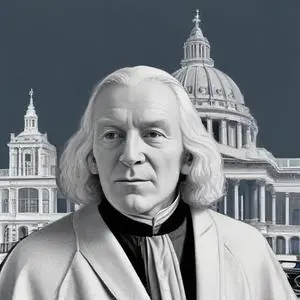
A renowned 17th-century polymath who made groundbreaking contributions to physics, mathematics, and architecture, designing iconic landmarks like St Paul's Cathedral. Their innovative works continue to inspire and influence modern architecture and design.
Sir Christopher Wren, one of the most renowned architects in English history, is best known for his magnificent contributions to the nation's architectural landscape, particularly in the rebuilding of London after the Great Fire of 1666. His masterpieces, including the iconic St Paul's Cathedral, have left an indelible mark on the country's cultural heritage.
Wren was born on October 20, 1632, in East Knoyle, Wiltshire, to Christopher Wren the Elder, a rector, and Mary Cox, a member of a prominent local family. Despite being a sickly child, Wren's intellectual curiosity and passion for learning propelled him to excel academically.
Wren pursued his education at the University of Oxford, where he studied Latin and Aristotelian physics. His academic prowess earned him a fellowship at All Souls College, Oxford, and later, a professorship in astronomy at Gresham College, London.
Wren's architectural journey began in the 1660s, when he was commissioned to design the Sheldonian Theatre at Oxford University. His innovative designs, blending classical and Baroque elements, quickly gained recognition, and he became the go-to architect for the English monarchy.
The Great Fire of 1666 presented Wren with an unprecedented opportunity to reshape London's skyline. He was appointed to oversee the rebuilding of 52 churches, including his magnum opus, St Paul's Cathedral.
St Paul's Cathedral (1675-1710) - A masterpiece of English Baroque architecture, featuring an imposing dome and a striking west front. Wren's design revolutionized church architecture and continues to inspire awe in visitors from around the world.
Wren's interdisciplinary approach to science and architecture led to significant contributions to fields beyond architecture. He was a founding member of the Royal Society and served as its president from 1680 to 1682.
Wren's scientific work, particularly in the fields of physics and astronomy, earned him recognition from luminaries like Isaac Newton and Blaise Pascal. His legacy extends beyond architecture to the realm of scientific inquiry.
Wren married Faith Coghill in 1669, and they had two children together. After Faith's passing, Wren married Jane Fitzwilliam in 1673. He died on February 25, 1723, at the age of 90, leaving behind a rich cultural heritage that continues to inspire generations.
Through his extraordinary body of work, Wren has left an indelible mark on England's cultural landscape. His visionary designs, blending functionality with beauty, have elevated the nation's architectural identity, forever changing the way we perceive and interact with our built environment.
Born in 1656
Predicted celestial events, including the return of a comet that bears his name, and made significant contributions to navigation, astronomy, and mathematics.
Born in 1564
Pioneering astronomer, physicist, and mathematician who played a major role in the Scientific Revolution, making key discoveries that challenged Aristotelian views and laid the foundation for modern science.
Born in 1571
A 17th-century trailblazer who discovered the three laws of planetary motion, revolutionizing our understanding of the solar system. He's also credited with being a pioneer in the field of astrology.
Born in 1749
Developed nebular hypothesis of the origin of the solar system and formulated Laplace's equation, a fundamental concept in mathematics and physics. He's considered the founder of celestial mechanics.
Born in 1623
A 17th-century genius who made major contributions to mathematics, physics, and philosophy, inventing the mechanical calculator and developing the theory of probability. His writings also explored the human condition and faith.
Born in 1596
Developed influential philosophical and mathematical concepts, including the famous phrase "I think, therefore I am," and laid the foundation for modern Western philosophy.
