


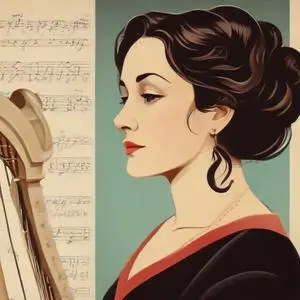
A renowned 19th-century pianist and composer, she was one of the first females to achieve recognition in a male-dominated field, creating over 60 pieces of music. Her compositions showcased romanticism and lyricism.
Clara Schumann was a German pianist, composer, and piano teacher who left an indelible mark on the world of classical music. Regarded as one of the most distinguished pianists of the Romantic era, she was known for her incredible talent, innovative approach to music, and trailblazing career that spanned over six decades.
Born on September 13, 1819, in Leipzig, Germany, Clara Schumann was the daughter of Friedrich Wieck, a renowned pianist and piano teacher, and Mariane Wieck, a singer. Clara was a child prodigy, and her father began training her in music from a very young age. She made her concert debut at the age of 11, and by the time she was 18, she was already an accomplished pianist.
Schumann's exceptional talent and dedication to music led her to become one of the most celebrated pianists of her time. She was known for her unique style, which emphasized musicality and expressiveness over technical virtuosity. Her concert programs often featured a mix of classical and contemporary works, including her own compositions.
Schumann was also a pioneer in changing the format and repertoire of the piano recital. She introduced a more intimate and personal approach to performance, often performing in smaller venues and featuring lesser-known works. This innovative approach helped to pave the way for future generations of pianists.
Schumann was a prolific composer, and her works include solo piano pieces, chamber music, choral pieces, and songs. Her compositions were often characterized by their lyricism, technical mastery, and emotional depth. Although she was overshadowed by her husband Robert Schumann during her lifetime, her music has experienced a resurgence in popularity in recent years.
Schumann's legacy extends beyond her music. She was a dedicated teacher and mentor, and her influence can be seen in the many students she taught throughout her career. She was also a devoted wife and mother, and her marriage to Robert Schumann produced eight children.
Schumann's personal life was marked by her marriage to Robert Schumann, a prominent composer and pianist. The couple had a deep and supportive relationship, and they frequently collaborated on musical projects. After Robert's death in 1856, Schumann continued to promote his music, editing and publishing his works.
Schumann also had a close relationship with Johannes Brahms, a composer and pianist who was a close friend and protégé of the Schumanns. Brahms often sought Clara's advice and criticism, and she played an important role in promoting his music.
Schumann's contributions to music were recognized during her lifetime and beyond. She was awarded the Gold Medal of the Royal Philharmonic Society in 1866, and she was featured on the 100 Deutsche Mark banknote from 1989 to 2002.
In recent years, Schumann's music has experienced a resurgence in popularity, and her 2019 bicentenary was marked by numerous concerts, exhibitions, and publications celebrating her life and work.
Clara Schumann was a true trailblazer in the world of classical music. Her innovative approach to performance, her prolific compositions, and her dedication to teaching and mentoring have left a lasting impact on the music world. As a pioneering female musician, Schumann paved the way for future generations of women in music, and her legacy continues to inspire and empower musicians today.
Born in 1810
A renowned Romantic-era composer and influential music critic, known for his expressive and emotionally charged works, including symphonies, piano music, and art songs.
Born in 1833
A renowned pianist and composer, he crafted complex, expressive works that blended traditional and innovative techniques, leaving an indelible mark on classical music.
Born in 1811
A virtuosic pianist and composer who revolutionized classical music with his technically demanding and emotionally expressive works, blending Hungarian folk influences with Romantic-era drama.
Born in 1810
A Polish pianist and composer renowned for his delicate, expressive, and technically demanding piano music that evokes deep emotions and continues to inspire generations of musicians and music lovers. His nocturnes, waltzes, and preludes are staples of classical music.
Born in 1841
A Czech composer and academic who blended folk influences with classical music, creating iconic works like the "New World Symphony".
Born in 1840
A renowned Russian composer and educator, he is best known for his iconic and beloved ballets, such as Swan Lake and The Nutcracker, which continue to enchant audiences worldwide.
Born in 1813
A renowned composer of iconic operas like La Traviata and Aida, known for his masterful blending of drama and music. His works continue to captivate audiences worldwide.
Born in 1813
A revolutionary composer who transformed opera with his epic, mythological works, creating a new era of musical storytelling. His iconic operas, such as "Der Ring des Nibelungen," continue to captivate audiences worldwide.
