


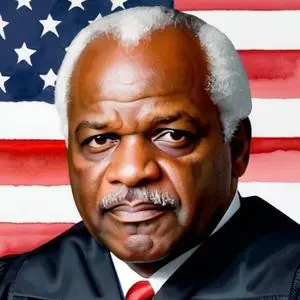
The longest-serving African American justice on the Supreme Court, known for his conservative views and influential opinions on affirmative action, gun rights, and the death penalty.
Clarence Thomas is an American lawyer and jurist who has served as an associate justice of the Supreme Court of the United States since 1991, making him the second African American to hold the position after Thurgood Marshall. He is known for his conservative views and has been a pivotal figure in shaping the Court's decisions on issues such as affirmative action, gun rights, and campaign finance reform.
Born on June 23, 1948, in Pin Point, Georgia, Thomas grew up in a poor Gullah community near Savannah. His father abandoned the family, and he was raised by his grandfather, who instilled in him the importance of hard work and education.
Thomas was raised as a devout Catholic and initially intended to become a priest. However, he became disillusioned with the Church's response to racism and decided to pursue a career in law instead.
Thomas attended the College of the Holy Cross and Yale Law School, where he was influenced by conservative authors such as Thomas Sowell. After graduating, he was appointed as an assistant attorney general in Missouri and later entered private practice.
Thomas's career in public service began in 1979, when he became a legislative assistant to U.S. Senator John Danforth. In 1981, he was appointed Assistant Secretary for Civil Rights at the U.S. Department of Education. President Ronald Reagan appointed him as Chairman of the Equal Employment Opportunity Commission (EEOC) in 1982, a position he held until 1990.
In 1990, President George H.W. Bush nominated Thomas to the United States Court of Appeals for the District of Columbia Circuit. He served in that role for 19 months before being nominated to the Supreme Court to succeed Thurgood Marshall.
Thomas's confirmation hearings were marked by controversy, particularly when Anita Hill, a former subordinate at the Department of Education and the EEOC, accused him of sexual harassment. Despite the intense scrutiny, Thomas was confirmed by the Senate with a narrow 52-48 vote.
Since joining the Supreme Court, Thomas has been a consistent voice for conservative ideology, often finding himself at odds with his liberal colleagues. He has written influential opinions on issues such as affirmative action, gun rights, and campaign finance reform, and has become known for his originalist approach to constitutional interpretation.
Thomas is a strong believer in originalism, the idea that the Constitution should be interpreted based on its original meaning at the time of its adoption. He has been critical of judicial activism and has argued that the Court should defer to the elected branches of government on many issues.
Thomas has been the subject of controversy throughout his career, particularly regarding his views on affirmative action and his handling of Anita Hill's accusations during his confirmation hearings. Despite this, he remains a respected figure in conservative circles and has been praised for his commitment to his principles.
As the longest-serving African American justice on the Supreme Court, Thomas has had a significant impact on American jurisprudence and society at large. His conservative views have shaped the Court's decisions on key issues, and his commitment to originalism has influenced a generation of jurists and legal scholars.
Thomas has received numerous awards and honors for his service, including the Presidential Medal of Freedom, the nation's highest civilian honor.
90 Years Old
A conservative Supreme Court Justice who played a significant role in shaping the court's decisions on issues like abortion, affirmative action, and gun rights, known for his originalist interpretation of the Constitution.
Born in 1917
A prominent Canadian politician who served as the 17th Premier of Ontario, known for his progressive policies and significant contributions to the province's development.
76 Years Old
An Associate Justice of the Supreme Court, known for conservative opinions and landmark decisions on issues like abortion and gun rights.
90 Years Old
A Supreme Court Justice who served for over 30 years, known for his swing votes and opinions on landmark cases, including same-sex marriage and abortion rights.
93 Years Old
A pioneering Supreme Court Justice and women's rights advocate who championed gender equality and became a cultural icon.
88 Years Old
An Associate Justice of the Supreme Court, known for interpreting the US Constitution and shaping the country's laws and policies through landmark decisions. A prominent figure in American jurisprudence, influencing the nation's social and political landscape.
72 Years Old
The first Hispanic and Latina member of the Supreme Court, known for her progressive views and powerful dissents that often speak to the experiences of marginalized communities.
66 Years Old
Associate Justice of the Supreme Court of the United States, serving since 2010 and known for her liberal stance and influential opinions on key cases. She is the fourth woman to serve on the Court.
