


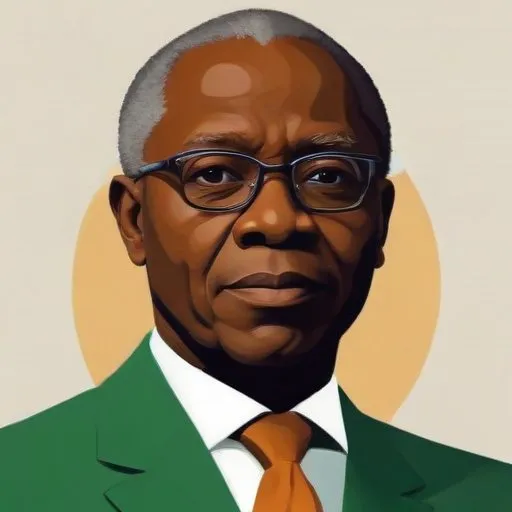
A renowned African scholar who made significant contributions to the fields of political science, development, and African studies, particularly in the areas of democracy, governance, and economic development.
Claude Ake, pronounced AH-kay, is renowned as one of Africa's most distinguished political philosophers. His groundbreaking research on development and democracy in Africa has earned him unparalleled recognition, solidifying his position as a leading authority in the field of political economy and political theory.
Born on February 18, 1939, in Omoku, Rivers State, Nigeria, Ake's academic pursuits began at a relatively young age. He earned his Ph.D. in 1966 from Columbia University, where he developed a strong foundation in political economy and theory.
Ake's illustrious academic career spanned multiple continents and institutions. He taught at prestigious universities, including Yale University in the United States, University of Nairobi in Kenya, and University of Dar es Salaam in Tanzania. However, his most notable tenure was as the professor of political economy and dean of the University of Port Harcourt's Faculty of Social Sciences in the 1970s and 1980s.
During his time at Yale, Ake taught two influential courses: "State in Africa" and "Aspects of Development and the State in Africa." His lectures not only captivated students but also inspired a new generation of political scientists.
Ake's work focused on the intricacies of power and its relationship with development in Africa. He famously wrote, "Power is everything, and those who control the coercive resources use it freely to promote their interests." This philosophical stance highlights his conviction that true democracy can only be achieved by addressing the unequal distribution of power in Africa.
Ake's permanent home was in Port Harcourt, where he remained committed to his academic pursuits and political activism. His unwavering dedication to Nigeria's development led him to become an outspoken critic of corruption and authoritarian rule in Africa.
Ake's work has had a profound impact on modern society, particularly in Africa. His research has influenced policymakers, scholars, and activists, shaping the discourse on development and democracy in the continent. His legacy continues to inspire a new generation of leaders and thinkers, working towards a more equitable and just society.
Ake's academic output includes numerous publications, articles, and book chapters. His most notable works include research on the African state, political economy, and development studies. He also contributed to various academic journals, including the African Journal of Political Economy.
Ake's work has transcended the academic sphere, influencing popular culture and inspiring a new generation of artists, writers, and thinkers. His ideas have been referenced in various forms of media, including literature, music, and film.
Ake's contributions to the field of political science have been recognized with various awards and honors. His work has been praised by scholars and institutions around the world, solidifying his position as a leading authority in African politics.
Claude Ake's legacy extends beyond his academic pursuits. He remains a symbol of intellectual excellence and a testament to the power of education in shaping society. His work continues to inspire and challenge scholars, policymakers, and activists, ensuring his ideas remain relevant in modern times.
As George Bond, director of the Institute of African Studies at Columbia University's School of International Public Affairs, aptly stated, "He was one of the preeminent scholars on African politics and a scholar-activist concerned with the development of Africa."
Ake's passing on November 7, 1996, marked the loss of a brilliant mind, but his ideas and contributions continue to resonate, shaping the discourse on development and democracy in Africa.
89 Years Old
A Nigerian general and politician who served as the 5th President of Nigeria, known for his efforts to stabilize the country's economy and promote democracy. He's also known for his role in brokering peace in several African countries.
68 Years Old
The first president in Nigeria to originate from the minority ethnic group, he's known for his efforts to reform the country's electoral system and his handling of the Boko Haram insurgency.
