


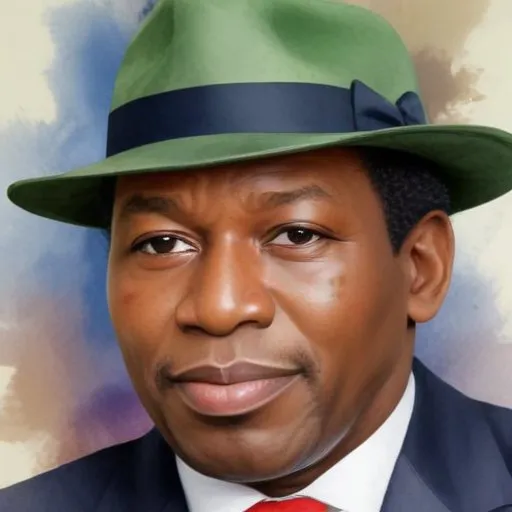
The first president in Nigeria to originate from the minority ethnic group, he's known for his efforts to reform the country's electoral system and his handling of the Boko Haram insurgency.
Goodluck Jonathan is a name synonymous with democracy and peaceful transition of power in Nigeria. As the first incumbent president in Nigerian history to concede defeat in an election, Jonathan's legacy is etched in the annals of Nigerian politics.
Born on November 20, 1957, in Ogbia, Bayelsa State, Goodluck Jonathan was raised in a Christian Ijaw family of canoe makers. His parents, Lawrence Ebele Jonathan and Eunice Ayi Ebele Jonathan, instilled in him the values of hard work and education.
Jonathan's educational pursuits took him to the University of Port Harcourt, where he earned a Bachelor's degree in Zoology, a Master's degree in Hydrobiology and Fisheries Biology, and a Doctorate in Zoology. During his time at the university, he taught at the Rivers State College of Education from 1983 to 1993.
Before entering politics, Jonathan worked as an education inspector, a lecturer, and an environmental protection officer. His political career began when he became involved with the Peoples Democratic Party (PDP) in the late 1990s.
In 1999, Jonathan's political career took a significant turn when he became the running mate to Diepreye Alamieyeseigha, the governorship candidate of the PDP in Bayelsa State. They won the election, and Jonathan served as the deputy governor of Bayelsa State from 1999 to 2005.
In 2005, Jonathan became the governor of Bayelsa State, serving until 2007. His leadership during this period was marked by significant improvements in infrastructure, education, and healthcare.
In 2007, Jonathan's political career reached new heights when he became the Vice President of Nigeria under the administration of Umaru Musa Yar'Adua. He served in this capacity until 2010, when he assumed the presidency following Yar'Adua's death.
One of Jonathan's most significant achievements is his decision to concede defeat in the 2015 presidential election to General Muhammadu Buhari. This marked the first time in Nigerian history that an incumbent president had peacefully transferred power to an opponent.
This remarkable act of statesmanship earned Jonathan international recognition and commendation. It solidified his legacy as a champion of democracy and a beacon of hope for a peaceful Nigeria.
Jonathan's leadership philosophy is rooted in his commitment to democracy, accountability, and social justice. He believes in the power of education and community development as catalysts for economic growth and social progress.
During his presidency, Jonathan implemented policies aimed at promoting economic development, enhancing national security, and improving healthcare. His administration also made significant investments in infrastructure, including roads, railways, and airports.
Jonathan's contributions to democracy and peace in Nigeria have earned him several awards and honors, including:
Today, Goodluck Jonathan remains a respected figure in Nigerian politics, known for his unwavering commitment to democracy and his unrelenting pursuit of peace and prosperity for the Nigerian people.
89 Years Old
A Nigerian general and politician who served as the 5th President of Nigeria, known for his efforts to stabilize the country's economy and promote democracy. He's also known for his role in brokering peace in several African countries.
75 Years Old
The 13th President of Nigeria, a businessman-turned-politician who implemented reforms to stabilize the country's economy and promoted national unity. He's also known for his humble and simple lifestyle.
83 Years Old
The 7th Head of State of Nigeria, a military leader who ruled the country from 1983 to 1985 and later became a democratically elected president, known for his anti-corruption efforts and economic reforms.
Born in 1904
First President of Nigeria, leading the country to independence from British colonial rule and shaping its early years as a sovereign nation.
Born in 1909
A Nigerian lawyer and politician who played a key role in the country's independence movement and was a strong advocate for democracy and education. He's also known for his efforts to develop Nigeria's economy and infrastructure.
47 Years Old
Nigerian professional footballer who played as a midfielder and won the African Cup of Nations with the Super Eagles in 1994. Known for his skills on the pitch and contributions to Nigerian football.
