


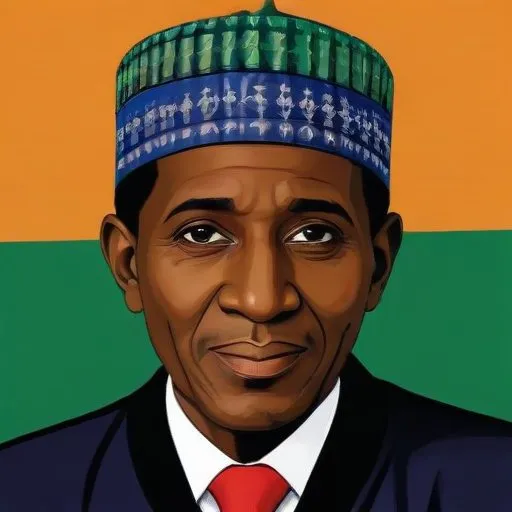
The 13th President of Nigeria, a businessman-turned-politician who implemented reforms to stabilize the country's economy and promoted national unity. He's also known for his humble and simple lifestyle.
Umaru Musa YarAdua was a Nigerian politician who served as the President of Nigeria from 2007 to 2010, leaving an indelible mark on the country's political landscape. Prior to his presidency, he held the position of Governor of Katsina State from 1999 to 2007, earning a reputation for his commitment to public service.
YarAdua was born on August 16, 1951, in Katsina State, Nigeria, into a family with a rich history of public service. His father, Musa YarAdua, was a Minister for Lagos in the First Republic and held the esteemed title of Matawalle, the custodian of the royal treasury of the Katsina Emirate. This title would eventually be inherited by YarAdua himself.
YarAdua's paternal grandfather, Malam Umaru, had also held the title of Matawallen Katsina, while his paternal grandmother, Binta, was a princess of the Katsina Emirate and a sister of Emir Muhammadu Dikko.
YarAdua's educational journey began at Rafukka Primary School in 1958, followed by Dutsinma Boarding Primary School in 1962. He then attended the Government College at Keffi from 1965 until 1969. In 1971, he received a Higher School Certificate from Barewa College.
He further pursued his education at Ahmadu Bello University in Zaria, where he obtained a Bachelor's degree in Education and Chemistry from 1972 to 1975. He returned to the university in 1978 to pursue a Master's degree in Analytical Chemistry.
YarAdua's political career began in 1999 when he was elected as the Governor of Katsina State, a position he held until 2007. During his tenure, he implemented various reforms aimed at improving the state's infrastructure, education, and healthcare systems.
In 2007, he was declared the winner of the Nigerian presidential election and was sworn in on May 29, 2007. As President, YarAdua focused on addressing the country's energy crisis, improving transportation infrastructure, and promoting economic development.
In 1975, YarAdua married Turai YarAdua, and they had seven children together – five daughters and two sons. He also had two children with his second wife, Hauwa Umar Radda, whom he married from 1992 to 1997.
In 2009, YarAdua traveled to Saudi Arabia for medical treatment, where he received treatment for pericarditis. He returned to Nigeria on February 24, 2010, but unfortunately passed away on May 5, 2010.
Umaru Musa YarAdua's legacy is characterized by his commitment to public service, his humility, and his dedication to improving the lives of Nigerians. Despite facing numerous challenges during his presidency, he remained resolute in his quest to transform the country.
Today, YarAdua's contributions to Nigeria's development continue to inspire generations of leaders and citizens alike, serving as a testament to the power of dedicated public service.
89 Years Old
A Nigerian general and politician who served as the 5th President of Nigeria, known for his efforts to stabilize the country's economy and promote democracy. He's also known for his role in brokering peace in several African countries.
68 Years Old
The first president in Nigeria to originate from the minority ethnic group, he's known for his efforts to reform the country's electoral system and his handling of the Boko Haram insurgency.
Born in 1904
First President of Nigeria, leading the country to independence from British colonial rule and shaping its early years as a sovereign nation.
Born in 1909
A Nigerian lawyer and politician who played a key role in the country's independence movement and was a strong advocate for democracy and education. He's also known for his efforts to develop Nigeria's economy and infrastructure.
47 Years Old
Nigerian professional footballer who played as a midfielder and won the African Cup of Nations with the Super Eagles in 1994. Known for his skills on the pitch and contributions to Nigerian football.
