


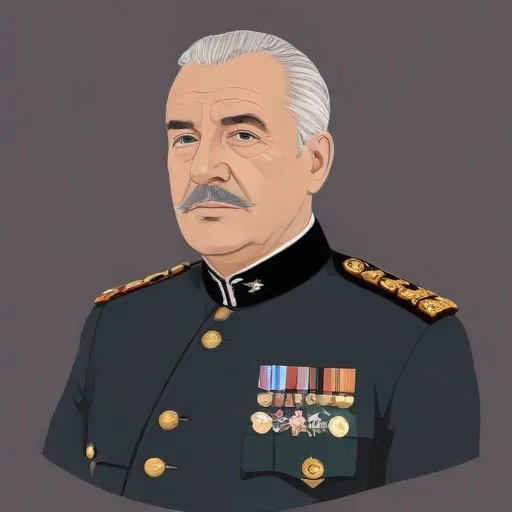
A British field marshal who played a crucial role in World War II, particularly in North Africa and the Middle East, and is remembered for his leadership and strategic decisions during the war.
Claude Auchinleck, a British Indian Army commander, is renowned for his illustrious military career, which spanned both World Wars. As Commander-in-Chief of the Indian Army, he played a pivotal role in shaping the course of British military strategy in India and beyond, earning him a revered place in the annals of military history.
Born on June 21, 1884, in Aldershot, Hampshire, Auchinleck's early life was shaped by his father's posting in British India. After his father's death in 1892, Auchinleck returned to England, where he attended Eagle House School and later Wellington College on scholarships. He then proceeded to the Royal Military College, Sandhurst, and was commissioned as an unattached second lieutenant in the Indian Army on January 21, 1903.
Auchinleck's early years in the Indian Army saw him serving with distinction in various capacities, including as a second lieutenant in the 62nd Punjabis in 1904. He rapidly rose through the ranks, earning a reputation as a skilled and fearless commander. By early 1941, he had become the Commander-in-Chief of the Indian Army, a position he held during the tumultuous years of World War II.
Auchinleck's military accomplishments are a testament to his strategic acumen and leadership prowess. In July 1941, he was appointed Commander-in-Chief of the Middle East Theatre, where he oversaw initial successes against the Axis powers. Although the war in North Africa ultimately turned against the British-led forces, Auchinleck's leadership played a crucial role in stabilizing the situation. In June 1943, he returned to India as Commander-in-Chief, where he orchestrated the organization of supply, maintenance, and training for General William Slim's Fourteenth Army, contributing significantly to its success.
Auchinleck's post-war career saw him assume the role of Supreme Commander of all British forces in India and Pakistan until late 1948. He played a vital part in the partition of India and the subsequent transition to independence. After retiring from the army, Auchinleck continued to serve as a respected military analyst and advisor, passing away on March 23, 1981, at the age of 96.
Auchinleck's military legacy extends beyond his own achievements to the development of modern military strategy and the shaping of India's independence movement. His contributions to the Indian Army's training and organizational structures have had a lasting impact on the country's defense forces.
“The soldier'spack is not so heavy as the officer's responsibility.” – Claude Auchinleck
Auchinleck's life and career were deeply intertwined with the tumultuous events of the 20th century. As a commander, he navigated the complexities of World War II, the decline of the British Empire, and the emergence of India as an independent nation. His legacy serves as a testament to the power of leadership and strategic thinking in the face of uncertainty.
Born in 1871
Prolific writer of historical novels and adventure stories, also a talented landscape painter.
Born in 1891
A renowned World War II military strategist, known for leading the Afrika Korps and earning the respect of both allies and enemies with his tactical genius.
Born in 1885
A renowned military leader who played a crucial role in World War II, particularly in the Allied victory in Europe, known for his bold tactics and unapologetic style.
Born in 1890
Led the Allied forces to victory in World War II and later served as President, maintaining peace and prosperity during the Cold War era. He's known for his strategic leadership and diplomatic skills.
