


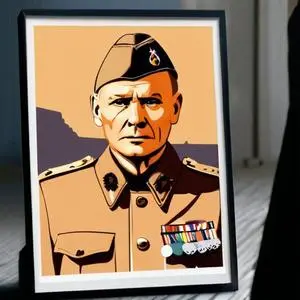
A renowned World War II military strategist, known for leading the Afrika Korps and earning the respect of both allies and enemies with his tactical genius.
Erwin Rommel, also known as the Desert Fox, was a highly decorated German field marshal during World War II, renowned for his exceptional military tactics and impressive leadership skills. He is best known for his role in the North African campaign, where he earned his nickname due to his cunning and clever strategies in the harsh desert terrain.
Erwin Rommel was born on November 15, 1891, in Heidenheim, Kingdom of Württemberg, German Empire. He joined the German Army in 1910 and saw action in World War I, where he was wounded multiple times. Rommel's bravery and exceptional leadership skills earned him the prestigious Pour le Mérite award, the highest military honor in Germany at the time.
In 1937, Rommel published his book, Infantry Attacks, a treatise on military tactics that became a classic in the field. The book was based on his experiences in World War I and provided valuable insights into modern warfare. Rommel's writing style was unique, and his book remains a valuable resource for military strategists to this day.
During World War II, Rommel commanded the 7th Panzer Division during the invasion of France in 1940. He later led German and Italian forces in the North African campaign, where he earned his legendary nickname, the Desert Fox. Rommel's cunning and adaptability in the harsh desert environment made him a formidable opponent, and his reputation as one of the greatest tank commanders of the war spread across the globe.
Rommel was known for his unique leadership style, which emphasized speed, surprise, and adaptability. He was a hands-on commander who led from the front, often putting himself in harm's way to inspire his troops. Rommel's chivalry and respect for his enemies earned him a reputation as a fair and honorable opponent, even among his British adversaries.
Rommel's involvement with the Nazi regime has been a subject of controversy among historians. While he was a supporter of Adolf Hitler, there is no clear evidence that he was aware of or involved in the regime's atrocities. Rommel's legacy has been the subject of much debate, with some viewing him as a brilliant military strategist and others seeing him as a willing participant in a reprehensible regime.
Rommel is often quoted as saying, "War without hate," a phrase that has been used to describe the relatively clean and chivalrous nature of the North African campaign. However, this phrase has been disputed by some historians, who argue that Rommel's involvement with the Nazi regime undermines his claim to chivalry.
Rommel's legacy remains complex and multifaceted, with some viewing him as a brilliant military strategist and others seeing him as a willing participant in the Nazi regime. Despite these controversies, Rommel's military prowess and leadership skills remain unparalleled, and his legacy continues to inspire military strategists and historians alike.
Born in 1889
The dictator of Nazi Germany, responsible for the genocide of six million Jews and millions of other people during World War II, and infamous for his extreme nationalist and anti-Semitic ideology.
Born in 1883
Italian fascist revolutionary and politician who led the National Fascist Party and ruled Italy from 1922 to 1943, known for his authoritarian regime and aggressive military campaigns.
Born in 1897
A mastermind of Nazi propaganda, he crafted a persuasive narrative that fueled the Third Reich's rise to power, leaving a lasting impact on the world.
Born in 1893
A high-ranking Nazi official, he was a decorated World War I fighter pilot and later became a prominent politician, serving as Minister President of Prussia. He's infamous for his role in the Nazi regime and war crimes trials.
Born in 1900
Leading the SS and Gestapo, he oversaw the Nazi regime's brutal security apparatus and implemented the "Final Solution," orchestrating the genocide of six million Jews during World War II.
Born in 1893
A German diplomat who served as the Nazi regime's Foreign Minister, orchestrating key alliances and treaties that led to World War II. He was a close associate of Adolf Hitler and played a crucial role in shaping Nazi foreign policy.
Born in 1876
A German naval leader who played a key role in the Kriegsmarine during World War II, overseeing the German U-boat fleet and naval operations. He was a close advisor to Adolf Hitler and implemented the German naval strategy during the war.
Born in 1891
A German naval commander who led the U-boat fleet during World War II and briefly served as President of Germany after Hitler's death, known for his role in the war and its aftermath.
