


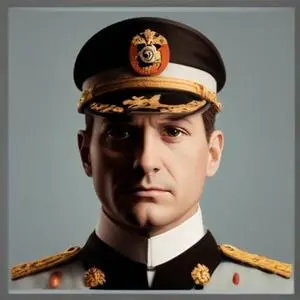
A German naval commander who led the U-boat fleet during World War II and briefly served as President of Germany after Hitler's death, known for his role in the war and its aftermath.
Karl Dnitz, a German admiral, is best known for succeeding Adolf Hitler as the head of state in May 1945, holding the position until the dissolution of the Flensburg Government following Germany's unconditional surrender to the Allies. As the Supreme Commander of the Navy, he played a major role in the naval history of World War II, earning him a notable place in history.
Born on September 16, 1891, in Grünau, Berlin, Dnitz began his career in the Imperial German Navy before World War I. During the war, he commanded UB-68, a German U-boat, and was taken prisoner of war by British forces in 1918.
After the war, Dnitz continued to serve in the German Navy, rising through the ranks to become the commander of the U-boat arm in 1935. He was instrumental in developing the concept of the "wolfpack" tactic, where U-boats operated in groups to attack Allied convoys, increasing their effectiveness.
By the start of World War II, Dnitz was the supreme commander of the Kriegsmarine's U-boat arm, and in January 1943, he achieved the rank of Grand Admiral, replacing Grand Admiral Erich Raeder as Commander-in-Chief of the Navy.
As the main enemy of Allied naval forces in the Battle of the Atlantic, Dnitz's U-boats fought effectively until May 1943, when the Allies gained the upper hand. Despite this, he continued to order his submarines into battle until 1945, in an effort to relieve the pressure on other branches of the Wehrmacht.
Dnitz's leadership and tactics during World War II resulted in significant losses for both the Allies and Germany. A total of 648 U-boats were lost, with 429 of them having no survivors. Furthermore, of these, 215 were lost on their first patrol, resulting in a staggering loss of life.
In 1946, Dnitz was tried and convicted of war crimes at the Nuremberg Trials, sentenced to 10 years in prison. He was released in 1956 and lived until his death on December 24, 1980.
Dnitz was a strong believer in the importance of the U-boat arm in the German Navy, and his leadership and tactics reflected this. He also believed in the concept of the "wolfpack" tactic, which he developed and implemented during the war.
Despite his controversial legacy, Dnitz's contributions to naval warfare are undeniable, and his tactics continue to be studied by naval historians and strategists today.
Dnitz was known for his strict discipline and professionalism, earning him the respect of his peers and subordinates. He was also known for his loyalty to the German Navy and his country, even in the face of defeat.
In his personal life, Dnitz was married to Ingeborg Weber, and they had two daughters and a son together. His son, Klaus, was killed in action in 1944.
Karl Dnitz's legacy is a complex and controversial one, marked by both his significant contributions to naval warfare and the devastating losses suffered during World War II. Despite this, he remains an important figure in naval history, and his tactics and leadership continue to be studied and debated by historians and strategists today.
Born in 1889
The dictator of Nazi Germany, responsible for the genocide of six million Jews and millions of other people during World War II, and infamous for his extreme nationalist and anti-Semitic ideology.
Born in 1893
A high-ranking Nazi official, he was a decorated World War I fighter pilot and later became a prominent politician, serving as Minister President of Prussia. He's infamous for his role in the Nazi regime and war crimes trials.
Born in 1897
A mastermind of Nazi propaganda, he crafted a persuasive narrative that fueled the Third Reich's rise to power, leaving a lasting impact on the world.
Born in 1876
A German naval leader who played a key role in the Kriegsmarine during World War II, overseeing the German U-boat fleet and naval operations. He was a close advisor to Adolf Hitler and implemented the German naval strategy during the war.
Born in 1900
Leading the SS and Gestapo, he oversaw the Nazi regime's brutal security apparatus and implemented the "Final Solution," orchestrating the genocide of six million Jews during World War II.
Born in 1893
A German diplomat who served as the Nazi regime's Foreign Minister, orchestrating key alliances and treaties that led to World War II. He was a close associate of Adolf Hitler and played a crucial role in shaping Nazi foreign policy.
Born in 1882
A high-ranking Nazi officer who served as the Chief of the OKW, the German High Command, during World War II, and was known for his unwavering loyalty to Hitler. He was tried and executed for war crimes after the war.
Born in 1890
Chief of the German High Command during World War II, responsible for planning and executing military operations, and signing the unconditional surrender of Germany.
