


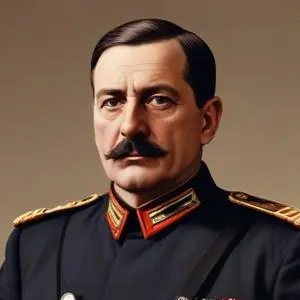
Chief of the German High Command during World War II, responsible for planning and executing military operations, and signing the unconditional surrender of Germany.
Alfred Jodl, a German Generaloberst, served as the Chief of the Operations Staff of the Oberkommando der Wehrmacht, the German Armed Forces High Command, throughout World War II. He is infamously known for his role in planning and executing the war, which led to his trial and execution after the war.
Alfred Jodl was born on May 10, 1890, in Würzburg, Germany. He was educated at a military cadet school in Munich, graduating in 1910. His younger brother, Ferdinand Jodl, also became an army general. Interestingly, Alfred's uncle was Friedrich Jodl, a renowned philosopher and psychologist at the University of Vienna.
Jodl served with a battery unit on the Western Front from 1914 to 1916, earning the Iron Cross 2nd Class for gallantry in November 1914. He was wounded in action and briefly served on the Eastern Front in 1917 before returning to the West as a staff officer. In 1918, he received the Iron Cross 1st Class for gallantry in action. After Germany's defeat, Jodl continued his career as a professional soldier with the reduced German Army, the Reichswehr.
In the late 1930s, Jodl became a major in the operations branch of the Truppenamt (Troop Office) in the Army High Command, serving under General Ludwig Beck. In September 1939, Jodl met Adolf Hitler for the first time. During the buildup to World War II, Jodl was nominally assigned as commander of the 44th Division, but his real influence lay in his role as Chief of the Operations Staff of the Oberkommando der Wehrmacht.
After the war, Jodl was indicted on charges of conspiracy to commit crimes against peace, planning, initiating, and waging wars of aggression, war crimes, and crimes against humanity at the Allied-organized Nuremberg trials. The principal charges against him related to his signature of the criminal Commando and Commissar Orders. Found guilty on all charges, Jodl was sentenced to death and executed by hanging in Nuremberg on October 16, 1946.
Jodl married twice, first in 1913 and again after becoming a widower in 1944. While he was raised Roman Catholic, he rejected the faith later in life. Today, Jodl is remembered as a controversial figure, whose actions and decisions during World War II had far-reaching consequences.
Alfred Jodl's story serves as a reminder of the devastating consequences of war and the importance of holding those in power accountable for their actions.
Born in 1889
The dictator of Nazi Germany, responsible for the genocide of six million Jews and millions of other people during World War II, and infamous for his extreme nationalist and anti-Semitic ideology.
Born in 1893
A high-ranking Nazi official, he was a decorated World War I fighter pilot and later became a prominent politician, serving as Minister President of Prussia. He's infamous for his role in the Nazi regime and war crimes trials.
Born in 1897
A mastermind of Nazi propaganda, he crafted a persuasive narrative that fueled the Third Reich's rise to power, leaving a lasting impact on the world.
Born in 1900
Leading the SS and Gestapo, he oversaw the Nazi regime's brutal security apparatus and implemented the "Final Solution," orchestrating the genocide of six million Jews during World War II.
Born in 1893
A German diplomat who served as the Nazi regime's Foreign Minister, orchestrating key alliances and treaties that led to World War II. He was a close associate of Adolf Hitler and played a crucial role in shaping Nazi foreign policy.
Born in 1894
A high-ranking Nazi official who flew to Scotland on a solo mission to negotiate peace with the UK, but was instead arrested and imprisoned.
Born in 1891
A German naval commander who led the U-boat fleet during World War II and briefly served as President of Germany after Hitler's death, known for his role in the war and its aftermath.
Born in 1882
A high-ranking Nazi officer who served as the Chief of the OKW, the German High Command, during World War II, and was known for his unwavering loyalty to Hitler. He was tried and executed for war crimes after the war.
