


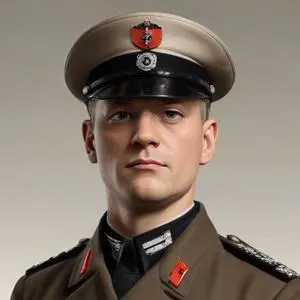
A German diplomat who served as the Nazi regime's Foreign Minister, orchestrating key alliances and treaties that led to World War II. He was a close associate of Adolf Hitler and played a crucial role in shaping Nazi foreign policy.
Joachim von Ribbentrop was a German politician and diplomat who served as Minister of Foreign Affairs of Nazi Germany from 1938 to 1945, playing a pivotal role in brokering the Molotov-Ribbentrop Pact and the Pact of Steel, two alliances that reshaped the global landscape on the eve of World War II. As a close confidant of Adolf Hitler, Ribbentrop's diplomatic maneuvers had far-reaching consequences, ultimately contributing to the devastation of the war and the horrors of the Holocaust.
Born on April 30, 1893, in Wesel, Rhenish Prussia, Ribbentrop came from a middle-class family with a strong military tradition. He was educated at a private school in Metz, France, and later studied business in Hamburg and London. Ribbentrop's early career was marked by stints as a soldier, a pilot, and a businessman, allowing him to develop a unique understanding of international relations and foreign affairs.
Ribbentrop's connections with Hitler began in the early 1930s, when he hosted secret meetings at his estate, Schloss Fuschl, which led to Hitler's appointment as Chancellor of Germany. As Hitler's influence grew, so did Ribbentrop's. He became a close advisor, leveraging his expertise in foreign affairs to secure key diplomatic positions, including ambassador to the Court of St. James's in 1936 and Foreign Minister of Germany in 1938.
Ribbentrop's diplomatic efforts were instrumental in shaping the course of World War II. He brokered the Molotov-Ribbentrop Pact, a non-aggression treaty between Nazi Germany and the Soviet Union, which stunned the international community and temporarily secured a fragile peace. He also played a key role in negotiating the Pact of Steel, an alliance with Fascist Italy that solidified the Axis powers.
As the war effort faltered, Ribbentrop's influence began to wane. He opposed the invasion of the Soviet Union, and his attempts to salvage relations with the Soviets were ultimately unsuccessful. Following Germany's defeat, Ribbentrop was arrested in June 1945 and put on trial at Nuremberg. Convicted of war crimes and crimes against humanity, he was sentenced to death and executed by hanging on October 16, 1946.
Ribbentrop's legacy is one of diplomatic manipulation and catastrophic consequences. His attempt to secure short-term gains through alliances ultimately contributed to the devastation of World War II and the brutality of the Holocaust. As a symbol of Nazi Germany's aggression and brutality, Ribbentrop's name remains synonymous with the darker aspects of human history.
"England is a very, very old country, and it is a great pity that it has gone so far down."
"It is impossible for me to understand how the Americans can be so naive."
Born in 1889
The dictator of Nazi Germany, responsible for the genocide of six million Jews and millions of other people during World War II, and infamous for his extreme nationalist and anti-Semitic ideology.
Born in 1897
A mastermind of Nazi propaganda, he crafted a persuasive narrative that fueled the Third Reich's rise to power, leaving a lasting impact on the world.
Born in 1893
A high-ranking Nazi official, he was a decorated World War I fighter pilot and later became a prominent politician, serving as Minister President of Prussia. He's infamous for his role in the Nazi regime and war crimes trials.
Born in 1900
Leading the SS and Gestapo, he oversaw the Nazi regime's brutal security apparatus and implemented the "Final Solution," orchestrating the genocide of six million Jews during World War II.
Born in 1894
A high-ranking Nazi official who flew to Scotland on a solo mission to negotiate peace with the UK, but was instead arrested and imprisoned.
Born in 1876
A German naval leader who played a key role in the Kriegsmarine during World War II, overseeing the German U-boat fleet and naval operations. He was a close advisor to Adolf Hitler and implemented the German naval strategy during the war.
Born in 1873
A German diplomat who served as Foreign Minister during the Nazi era, known for his role in shaping Germany's aggressive foreign policy and supporting the annexation of Austria.
Born in 1881
A German field marshal who played a crucial role in the Nazi war effort, serving as the commander-in-chief of the German Army from 1938 to 1941. He was a key figure in the invasion of Poland and the Battle of France.
