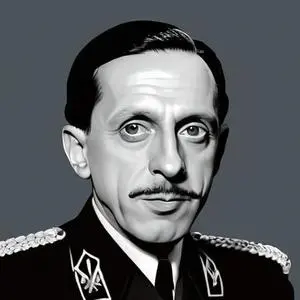
Joseph Goebbels

Joseph Goebbels

Joseph Goebbels was born on October 29th, 1897

Full Name: Joseph Goebbels
Profession: Lawyer
Nationality: German
Party: Nazi Party
Career: Politician
Known For: Propaganda Minister
Occupation: Chancellor
Government: Nazi Germany

A mastermind of Nazi propaganda, he crafted a persuasive narrative that fueled the Third Reich's rise to power, leaving a lasting impact on the world.

Joseph Goebbels: The Architect of Nazi Propaganda

Early Life and Education

Joseph Goebbels, the German Nazi politician and philologist, was born on October 29, 1897, in Rheydt, Germany. He is best known for his role as the chief propagandist for the Nazi Party and Reich Minister of Propaganda from 1933 to 1945, using his exceptional oratory skills to disseminate the party's ideology and promote Adolf Hitler's agenda.

Goebbels obtained a doctorate in philology from the University of Heidelberg in 1921, with a dissertation on the 18th-century German romantic novelist Wilhelm Schütz. His academic background in literature and language would later serve as the foundation for his mastery of propaganda techniques.

Rise to Prominence

Goebbels joined the Nazi Party in 1924, where he worked closely with Gregor Strasser in the party's northern branch. His talent for public speaking and writing caught the attention of Adolf Hitler, who appointed him Gauleiter (district leader) of Berlin in 1926. In this position, Goebbels began to develop his skills in propaganda, using newspapers, posters, and other media to promote the Nazi Party and its agenda.

Minister of Propaganda and National Enlightenment

After the Nazis came to power in 1933, Goebbels was appointed Reich Minister of Propaganda and National Enlightenment, a position that gave him control over the news media, arts, and information in Nazi Germany. He used this power to disseminate anti-Semitic and anti-communist propaganda, as well as to promote the Nazi Party's ideology and policies.

Goebbels was a pioneer in the use of radio and film for propaganda purposes, recognizing the potential of these media to reach a wide audience and shape public opinion. He established the Reich Chamber of Culture, which oversaw the production of films, music, and art that promoted Nazi ideology.

Total War and the Final Years

As World War II turned against Germany, Goebbels became increasingly radicalized, advocating for a policy of total war and sacrifice. In 1943, he began to pressure Hitler to introduce measures that would mobilize the entire German population for the war effort, including closing non-essential businesses, conscripting women into the labor force, and enlisting men in previously exempt occupations into the Wehrmacht.

In 1944, Hitler appointed Goebbels as Reich Plenipotentiary for Total War, granting him sweeping powers to reorganize the German economy and mobilize the population for the war effort. However, these measures were largely unsuccessful in stemming the tide of defeat.

Personal Life and Legacy

Goebbels was married to Magda Goebbels, with whom he had six children. The family's personal life was marked by tragedy, including the death of their son Harald in 1945.

Joseph Goebbels' legacy is inextricably linked with the atrocities committed by the Nazi regime, including the Holocaust and the systematic persecution of Jews, homosexuals, Romani people, and others deemed undesirable by the Nazi state. His propaganda machine played a crucial role in promoting these policies and shaping public opinion in Nazi Germany.

Quotes and Memorable Sayings

Historical Context and Legacy

Goebbels' propaganda machine played a significant role in shaping the historical context of Nazi Germany, promoting an ideology of hatred, intolerance, and aggression. His legacy serves as a reminder of the dangers of unchecked power, propaganda, and the manipulation of public opinion.

In the aftermath of World War II, Goebbels' name became synonymous with the Nazi regime's atrocities, and his legacy has been the subject of intense scrutiny and criticism by historians and scholars.

Timeline
1897
Born in Rheydt, Germany
Joseph Goebbels was born on October 29th in Rheydt, Germany, to a Catholic family.
1924
Joined the Nazi Party
Goebbels joined the Nazi Party, becoming one of Adolf Hitlers closest associates.
1933
Appointed Minister of Propaganda
Goebbels was appointed Minister of Propaganda and National Enlightenment by Hitler.
1945
Committed suicide in Berlin
Goebbels committed suicide in Berlin, along with his wife and six children, as Allied forces closed in on the city.
Joseph Goebbels

Joseph Goebbels Quiz

What was Joseph Goebbels' primary role in the Nazi regime?

Score: 0/5
FAQ
What was Joseph Goebbels role in Nazi Germany?
Joseph Goebbels was a key figure in Nazi Germany, serving as the Minister of Propaganda and National Enlightenment from 1933 to 1945. He was responsible for promoting the Nazi ideology and manipulating public opinion to support the regimes policies.
What were Joseph Goebbels early life and education like?
Joseph Goebbels was born on October 29, 1897, in Rheydt, Germany. He studied literature and philosophy at the University of Heidelberg, where he earned his Ph.D. in 1921.
How did Joseph Goebbels rise to power in the Nazi Party?
Joseph Goebbels joined the Nazi Party in 1924 and quickly rose through the ranks, becoming the Gauleiter of Berlin in 1926. He played a key role in promoting Hitlers candidacy for president and was appointed Minister of Propaganda in 1933.
What were some of Joseph Goebbels most significant propaganda campaigns?
Joseph Goebbels was responsible for several notable propaganda campaigns, including the Degenerate Art exhibition, which targeted modern art and artists deemed subversive by the Nazi regime. He also orchestrated the Reichskristallnacht pogrom, which targeted Jewish communities across Germany.
What was Joseph Goebbels fate at the end of World War II?
As Allied forces closed in on Berlin, Joseph Goebbels and his family moved into the Führerbunker with Hitler. On May 1, 1945, Goebbels and his wife Magda poisoned their six children before committing suicide together.

Related People:

Adolf Hitler

Born in 1889

The dictator of Nazi Germany, responsible for the genocide of six million Jews and millions of other people during World War II, and infamous for his extreme nationalist and anti-Semitic ideology.

Hermann Göring

Born in 1893

A high-ranking Nazi official, he was a decorated World War I fighter pilot and later became a prominent politician, serving as Minister President of Prussia. He's infamous for his role in the Nazi regime and war crimes trials.

Joachim von Ribbentrop

Born in 1893

A German diplomat who served as the Nazi regime's Foreign Minister, orchestrating key alliances and treaties that led to World War II. He was a close associate of Adolf Hitler and played a crucial role in shaping Nazi foreign policy.

Rudolf Hess

Born in 1894

A high-ranking Nazi official who flew to Scotland on a solo mission to negotiate peace with the UK, but was instead arrested and imprisoned.

Heinrich Himmler

Born in 1900

Leading the SS and Gestapo, he oversaw the Nazi regime's brutal security apparatus and implemented the "Final Solution," orchestrating the genocide of six million Jews during World War II.

Reinhard Heydrich

Born in 1904

A high-ranking Nazi official and chief architect of the Holocaust, responsible for implementing the "Final Solution" that led to the murder of six million Jews and millions of others during World War II.

Albert Speer

Born in 1905

A prominent figure in Nazi Germany, serving as Minister of Armaments and War Production, known for his architectural designs and role in the war effort.

Erich Raeder

Born in 1876

A German naval leader who played a key role in the Kriegsmarine during World War II, overseeing the German U-boat fleet and naval operations. He was a close advisor to Adolf Hitler and implemented the German naval strategy during the war.