


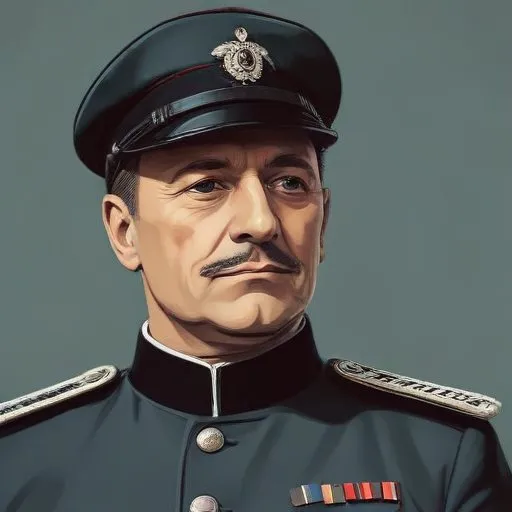
A German lieutenant and politician who was a prominent figure in the Nazi Party, known for his radical anti-capitalist and socialist views that influenced the party's early ideology.
Gregor Strasser, a German politician and early leader of the Nazi Party, is best known for his radical nationalism and anticapitalist ideology, which brought him into conflict with Adolf Hitler and ultimately led to his tragic demise. As a leading figure in the party's left-wing faction, Strasser played a significant role in shaping the Nazi Party's early years and its eventual rise to power.
Born on May 31, 1892, in Geisenfeld, Bavaria, Strasser served in the Imperial German Army during World War I, rising to the rank of first lieutenant and earning the Iron Cross of both classes for bravery. After the war, he joined Franz Ritter von Epp's Freikorps, a paramilitary organization that fought against communists and anarchists in post-war Germany.
In 1920, Strasser joined the Nazi Party, quickly becoming an influential figure in the fledgling organization. His exceptional organizational skills and charismatic public speaking abilities made him a valuable asset to the party. Strasser played a key role in the abortive Beer Hall Putsch in 1923, for which he was imprisoned. However, following his early release after being elected to the Reichstag, he rejoined the Nazi Party in 1925 and continued to rise through the ranks.
Strasser's radical nationalism and anticapitalist ideology set him apart from other Nazi leaders. He advocated for a more socialist and revolutionary approach, which clashed with Hitler's more pragmatic and conservative views. Strasser's vision for Germany involved a radical transformation of the economy and society, with a focus on social justice and equality.
The differences between Strasser and Hitler's ideologies ultimately led to a bitter feud. At the 1926 Bamberg Conference, Hitler publicly repudiated Strasser's radical wing of the party, marking a turning point in their relationship. Despite temporary reconciliations, the tension between the two leaders continued to escalate, culminating in Strasser's forced resignation from all party offices in 1932.
In a final attempt to reconcile, Chancellor Kurt von Schleicher offered Strasser the post of Vice-Chancellor, which only served to further isolate him within the party. Hitler's jealousy and paranoia eventually led to Strasser's murder on June 30, 1934, during the Night of the Long Knives, a purge of perceived enemies within the Nazi Party.
Gregor Strasser's legacy is complex and multifaceted. While his radical nationalism and anticapitalist ideology were influential in shaping the Nazi Party's early years, his eventual demise served as a warning to others who dared challenge Hitler's authority. Despite his flaws and controversies, Strasser's tragic story serves as a reminder of the dangers of unchecked power and the importance of critical thinking in politics.
In contrast to Hitler's pragmatic and conservative approach, Strasser's radical wing of the Nazi Party offered a unique blend of nationalist and socialist ideologies. While Ernst Röhm, another prominent Nazi leader, shared some similarities with Strasser's radical views, their differences ultimately led to Röhm's downfall as well.
Gregor Strasser's fascinating and tragic story serves as a testament to the complexities and dangers of politics in Nazi Germany. His radical ideology and charismatic leadership style continue to captivate historians and scholars, offering a unique window into the tumultuous early years of the Nazi Party.
Born in 1889
The dictator of Nazi Germany, responsible for the genocide of six million Jews and millions of other people during World War II, and infamous for his extreme nationalist and anti-Semitic ideology.
Born in 1887
A high-ranking Nazi official who played a key role in the party's early development and was a close ally of Adolf Hitler, but was eventually purged and executed during the Night of the Long Knives. He's infamous for his leadership of the Sturmabteilung (SA) paramilitary group.
Born in 1893
A high-ranking Nazi official, he was a decorated World War I fighter pilot and later became a prominent politician, serving as Minister President of Prussia. He's infamous for his role in the Nazi regime and war crimes trials.
Born in 1897
A mastermind of Nazi propaganda, he crafted a persuasive narrative that fueled the Third Reich's rise to power, leaving a lasting impact on the world.
Born in 1894
A high-ranking Nazi official who flew to Scotland on a solo mission to negotiate peace with the UK, but was instead arrested and imprisoned.
Born in 1900
Leading the SS and Gestapo, he oversaw the Nazi regime's brutal security apparatus and implemented the "Final Solution," orchestrating the genocide of six million Jews during World War II.
Born in 1893
A German diplomat who served as the Nazi regime's Foreign Minister, orchestrating key alliances and treaties that led to World War II. He was a close associate of Adolf Hitler and played a crucial role in shaping Nazi foreign policy.
Born in 1876
A German naval leader who played a key role in the Kriegsmarine during World War II, overseeing the German U-boat fleet and naval operations. He was a close advisor to Adolf Hitler and implemented the German naval strategy during the war.
