


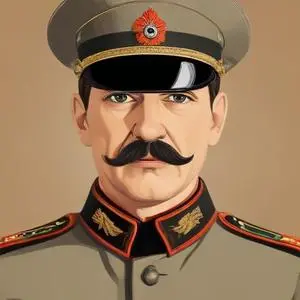
A German general and politician who briefly served as Chancellor of Germany in 1933, known for his failed attempts to stabilize the Weimar Republic and his role in Hitler's rise to power.
Kurt von Schleicher, a German general and politician, is notoriously known for being the penultimate Chancellor of Germany during the tumultuous Weimar Republic era, and his subsequent murder by Adolf Hitler's SS during the Night of the Long Knives in 1934.
Schleicher's legacy is inextricably linked with his role as a rival for power with Hitler, as well as his attempts to navigate the treacherous landscape of German politics during a period of great upheaval.
Born on April 7, 1882, in Brandenburg an der Havel, Schleicher was destined for a life of military service, hailing from a family with a rich military heritage.
Schleicher's influence extended far beyond the military realm, as he emerged as a crucial advisor to President Paul von Hindenburg from 1926 onwards.
Schleicher's meteoric rise culminated in his appointment as Chancellor on December 3, 1932, following the dismissal of Franz von Papen.
Schleicher's ill-fated attempt to counter Hitler's rise to power ultimately sealed his fate, as he was brutally murdered by the SS on June 30, 1934, during the Night of the Long Knives.
In the aftermath of his death, Schleicher's legacy has been marked by controversy, with some historians portraying him as a cunning opportunist, while others see him as a tragic figure who attempted to stem the tide of Nazi tyranny.
Regardless, Kurt von Schleicher's tumultuous career serves as a poignant reminder of the complexities and dangers of politics during one of the most tumultuous periods in modern history.
Born in 1889
The dictator of Nazi Germany, responsible for the genocide of six million Jews and millions of other people during World War II, and infamous for his extreme nationalist and anti-Semitic ideology.
Born in 1847
A German field marshal and politician who served as the 2nd President of Germany during the Weimar Republic, playing a crucial role in the rise of the Nazi Party. He's infamous for appointing Adolf Hitler as Chancellor of Germany in 1933.
Born in 1887
A high-ranking Nazi official who played a key role in the party's early development and was a close ally of Adolf Hitler, but was eventually purged and executed during the Night of the Long Knives. He's infamous for his leadership of the Sturmabteilung (SA) paramilitary group.
Born in 1893
A high-ranking Nazi official, he was a decorated World War I fighter pilot and later became a prominent politician, serving as Minister President of Prussia. He's infamous for his role in the Nazi regime and war crimes trials.
Born in 1897
A mastermind of Nazi propaganda, he crafted a persuasive narrative that fueled the Third Reich's rise to power, leaving a lasting impact on the world.
Born in 1900
Leading the SS and Gestapo, he oversaw the Nazi regime's brutal security apparatus and implemented the "Final Solution," orchestrating the genocide of six million Jews during World War II.
Born in 1893
A German diplomat who served as the Nazi regime's Foreign Minister, orchestrating key alliances and treaties that led to World War II. He was a close associate of Adolf Hitler and played a crucial role in shaping Nazi foreign policy.
Born in 1882
A high-ranking Nazi officer who served as the Chief of the OKW, the German High Command, during World War II, and was known for his unwavering loyalty to Hitler. He was tried and executed for war crimes after the war.
