


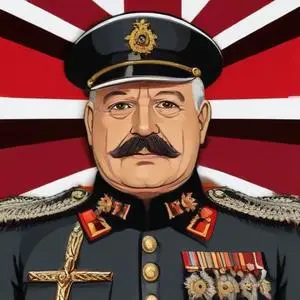
A German field marshal and politician who served as the 2nd President of Germany during the Weimar Republic, playing a crucial role in the rise of the Nazi Party. He's infamous for appointing Adolf Hitler as Chancellor of Germany in 1933.
Paul von Hindenburg is renowned for leading the Imperial German Army during World War I and later serving as the President of Germany from 1925 until his death in 1934. He played a pivotal role in the Nazi seizure of power in 1933, appointing Adolf Hitler as the Chancellor of Germany under pressure from his advisers.
Born on October 2, 1847, in Posen, Prussia (now Poznań, Poland), Hindenburg came from a family of minor Prussian nobility. He completed his education as a cadet and enlisted in the Third Regiment of Foot Guards as a second lieutenant.
He saw combat during the Austro-Prussian and Franco-Prussian wars, and in 1873, he was admitted to the prestigious Kriegsakademie in Berlin, where he studied for three years before being appointed to the Army's General Staff Corps.
After a five-year teaching stint at the Kriegsakademie, Hindenburg steadily rose through the army's ranks to become a lieutenant general by 1900. He was promoted to General of the Infantry in 1905, and Count Alfred von Schlieffen recommended him to succeed as Chief of the Great General Staff, although the post ultimately went to Helmuth von Moltke in 1906.
In 1911, Hindenburg announced his retirement from the military, but he was recalled to service in 1914 at the outbreak of World War I. He achieved fame on the Eastern Front as the victor of Tannenberg, overseeing a series of crushing victories against the Russians that made him a national hero and the center of a massive personality cult.
By 1925, Hindenburg's popularity had endured, and he was elected as the President of Germany. He served in this position until his death on August 2, 1934.
During his presidency, Hindenburg's decision to appoint Adolf Hitler as Chancellor in 1933, under pressure from his advisers, marked a significant turning point in German history, ultimately contributing to the rise of the Nazi regime.
Hindenburg's legacy is complex and multifaceted. While he is remembered as a national hero for his military victories, his role in the Nazi seizure of power has drawn criticism and controversy.
Despite this, his impact on German history and politics remains undeniable, and his story serves as a powerful reminder of the importance of responsible leadership and decision-making.
Hindenburg's life and legacy are intimately tied to the tumultuous period of German history during the early 20th century. His actions and decisions had far-reaching consequences, shaping the course of German politics and society for generations to come.
Through his story, we are reminded of the importance of understanding the complexities of history and the need for responsible leadership in times of crisis.
Born in 1889
The dictator of Nazi Germany, responsible for the genocide of six million Jews and millions of other people during World War II, and infamous for his extreme nationalist and anti-Semitic ideology.
Born in 1865
A German general and politician who played a crucial role in World War I, masterminding the 1918 Spring Offensive and later promoting Nazi ideology.
Born in 1879
A German nobleman who served as Chancellor of Germany in 1932, known for his role in appointing Adolf Hitler as Chancellor, paving the way for the Nazi regime.
Born in 1912
Developed the V-2 rocket for Nazi Germany and later led the team that created the Saturn V rocket that took humans to the moon.
Born in 1893
A high-ranking Nazi official, he was a decorated World War I fighter pilot and later became a prominent politician, serving as Minister President of Prussia. He's infamous for his role in the Nazi regime and war crimes trials.
Born in 1897
A mastermind of Nazi propaganda, he crafted a persuasive narrative that fueled the Third Reich's rise to power, leaving a lasting impact on the world.
Born in 1900
Leading the SS and Gestapo, he oversaw the Nazi regime's brutal security apparatus and implemented the "Final Solution," orchestrating the genocide of six million Jews during World War II.
