


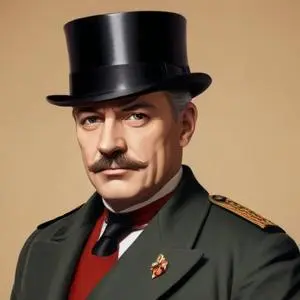
A German nobleman who served as Chancellor of Germany in 1932, known for his role in appointing Adolf Hitler as Chancellor, paving the way for the Nazi regime.
Franz von Papen, a German national conservative and diplomat, is infamously known for his role in bringing Adolf Hitler to power, serving as the Chancellor of Germany in 1932 and then as the Vice-Chancellor under Hitler from 1933 to 1934. His tumultuous political career was marked by controversy, power struggles, and a complex relationship with the Nazi Party.
Born on October 29, 1879, into a wealthy family of Westphalian Catholic aristocrats, Papen was trained as a German General Staff officer and served in the Prussian Army from 1898 onward. He was stationed in Mexico and the United States from 1913 to 1915, where he covertly organized acts of sabotage on behalf of German military intelligence and quietly backed and financed Mexican forces in the Mexican Revolution.
In 1932, Papen was asked by President Paul von Hindenburg to become the Chancellor of the Weimar Republic. He ruled by presidential decree, launching the Preußenschlag coup against the Social Democratic Party-led government in the Free State of Prussia. However, his failure to secure a base of support in the Reichstag led to his removal by Hindenburg and replacement by General Kurt von Schleicher.
Determined to return to power, Papen believed that Adolf Hitler could be controlled once he was in the government. He pressured Hindenburg to appoint Hitler as Chancellor and Papen as Vice-Chancellor in 1933, in a cabinet ostensibly not under Nazi Party domination. However, Papen and his allies were quickly marginalized by Hitler, and he left the government after the Night of the Long Knives in 1934, during which the Nazi Party purged its political opponents and consolidated power.
Papen's legacy is marred by his role in bringing Hitler to power and his failure to prevent the rise of the Nazi Party. He was tried at the Nuremberg Trials in 1945-1946, but was acquitted due to lack of evidence. Papen died on May 2, 1969, at the age of 89, leaving behind a complex and controversial legacy that continues to be debated by historians today.
Franz von Papen's story serves as a cautionary tale about the dangers of political opportunism and the consequences of underestimating the power of radical ideologies. His legacy serves as a reminder of the importance of strong democratic institutions and the need for political leaders to prioritize the well-being of their citizens over personal ambition.

Franz von Papen's life was marked by a series of tumultuous events that shaped the course of German history. From his early days as a military officer to his later years as a statesman, Papen's story serves as a reminder of the complexities of politics and the importance of moral courage in the face of adversity.
Born in 1889
The dictator of Nazi Germany, responsible for the genocide of six million Jews and millions of other people during World War II, and infamous for his extreme nationalist and anti-Semitic ideology.
Born in 1847
A German field marshal and politician who served as the 2nd President of Germany during the Weimar Republic, playing a crucial role in the rise of the Nazi Party. He's infamous for appointing Adolf Hitler as Chancellor of Germany in 1933.
Born in 1876
A German naval leader who played a key role in the Kriegsmarine during World War II, overseeing the German U-boat fleet and naval operations. He was a close advisor to Adolf Hitler and implemented the German naval strategy during the war.
Born in 1893
A high-ranking Nazi official, he was a decorated World War I fighter pilot and later became a prominent politician, serving as Minister President of Prussia. He's infamous for his role in the Nazi regime and war crimes trials.
Born in 1897
A mastermind of Nazi propaganda, he crafted a persuasive narrative that fueled the Third Reich's rise to power, leaving a lasting impact on the world.
Born in 1900
Leading the SS and Gestapo, he oversaw the Nazi regime's brutal security apparatus and implemented the "Final Solution," orchestrating the genocide of six million Jews during World War II.
Born in 1894
A high-ranking Nazi official who flew to Scotland on a solo mission to negotiate peace with the UK, but was instead arrested and imprisoned.
Born in 1893
A German diplomat who served as the Nazi regime's Foreign Minister, orchestrating key alliances and treaties that led to World War II. He was a close associate of Adolf Hitler and played a crucial role in shaping Nazi foreign policy.
