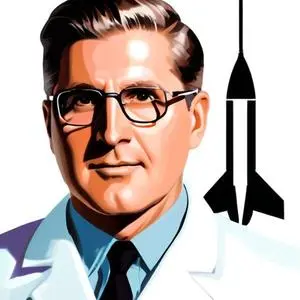
The Rocket Genius: Wernher von Braun
A Pioneer of Space Exploration
Wernher von Braun, the renowned German-American aerospace engineer and space architect, is credited with revolutionizing rocket technology and paving the way for human space travel. As the leading figure in the development of rocket technology in Nazi Germany and later a pioneer in the United States, von Braun's contributions to the field of aerospace engineering are unparalleled.
The Early Years
Born on March 23, 1912, in Wirsitz, Province of Posen, German Empire (now Wyrzysk, Poland), von Braun grew up with a passion for science and technology. He studied mechanical engineering at the Technical University of Berlin, where he earned his bachelor's degree in 1932. Later, he pursued his master's degree in physics from the University of Berlin, which he completed in 1934.
Wartime Contributions
During World War II, von Braun played a crucial role in the development of the V-2 rocket, the world's first long-range guided missile, at Peenemünde. The V-2 became the first artificial object to travel into space on June 20, 1944. As a member of the Nazi Party and Allgemeine SS, von Braun's involvement in the war effort has been a subject of controversy.
Operation Paperclip and the United States
Following the war, von Braun was secretly moved to the United States, along with about 1,600 other German scientists, engineers, and technicians, as part of Operation Paperclip. He worked for the United States Army on an intermediate-range ballistic missile program, developing the Jupiter-C rocket that launched the United States' first space satellite, Explorer 1, in 1958.
Collaboration with Walt Disney
Von Braun's work with
Walt Disney on a series of films from 1955 to 1957 popularized the idea of human space travel in the United States and beyond. The three-part series, "Man in Space," "Man and the Moon," and "Mars and Beyond," showcased von Braun's vision for space exploration.
NASA and the Saturn V
In 1960, von Braun's group was assimilated into NASA, where he served as director of the newly formed Marshall Space Flight Center. As the chief architect of the Saturn V super-heavy-lift launch vehicle, von Braun played a crucial role in the Apollo program, which successfully landed humans on the Moon in 1969.
Awards and Legacy
Von Braun received numerous awards and honors for his contributions to aerospace engineering, including the National Medal of Science in 1975. He was inducted into the National Academy of Engineering in 1967 and was posthumously inducted into the International Air & Space Hall of Fame in 1976.
Personal Life and Philosophy
Von Braun was known for his charismatic personality and his ability to inspire others. He advocated for a human mission to Mars and believed that space exploration was essential for human progress. Von Braun's personal life was marked by controversy, with some critics accusing him of escaping justice for his Nazi war crimes.
Impact on Modern Society
Wernher von Braun's contributions to space exploration have had a profound impact on modern society. His work on the Saturn V rocket paved the way for future space missions, and his advocacy for human space travel inspired generations of scientists and engineers. Today, von Braun is remembered as a pioneer in the field of aerospace engineering, and his legacy continues to inspire innovation and exploration.
Timeline
- 1912: Born on March 23 in Wirsitz, Province of Posen, German Empire (now Wyrzysk, Poland)
- 1932: Earned bachelor's degree in mechanical engineering from the Technical University of Berlin
- 1934: Earned master's degree in physics from the University of Berlin
- 1944: V-2 rocket becomes the first artificial object to travel into space
- 1955-1957: Collaborated with Walt Disney on a series of films
- 1958: Jupiter-C rocket launches the United States' first space satellite, Explorer 1
- 1960: Group assimilated into NASA; served as director of the Marshall Space Flight Center
- 1967: Inducted into the National Academy of Engineering
- 1969: Apollo program successfully lands humans on the Moon
- 1975: Received the National Medal of Science
- 1977: Died on June 16 in Alexandria, Virginia
Quotes
- "TheRocket will free men from their remaining chains."
- "Basic research is what I am doing when I don't know what I am doing."
- "It's only by doing what we love that we can be our best selves."
FAQ
What was Wernher von Brauns role in the development of the V-2 rocket?
Wernher von Braun was the technical director of the German V-2 rocket program during World War II, responsible for the design and development of the V-2 rocket. Sub-question: What was the significance of the V-2 rocket in World War II?
How did Wernher von Braun contribute to the US space program?
After surrendering to the US Army, Wernher von Braun led a team of scientists at the Redstone Arsenal in Huntsville, Alabama, developing the Jupiter-C rocket that launched the first US satellite, Explorer 1, into space.
What was Wernher von Brauns education and early career like?
Wernher von Braun studied mechanical engineering at the Technical University of Berlin and later earned his Ph.D. in physics from the University of Berlin. He worked at the German Aerospace Center and was involved in the development of liquid-fueled rockets.
What were Wernher von Brauns notable achievements and awards?
Wernher von Braun was awarded the National Medal of Science in 1975 and was inducted into the International Aerospace Hall of Fame in 1965. He was also a fellow of the American Institute of Aeronautics and Astronautics.
How did Wernher von Brauns work impact the development of modern rocketry?
Wernher von Brauns work on the V-2 rocket and later on the Saturn V rocket that landed astronauts on the Moon laid the foundation for modern rocketry, paving the way for space exploration and satellite technology.