


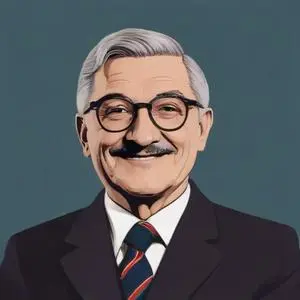
Pioneering rocket scientist and space travel theorist who laid the groundwork for modern astronautics, inspiring generations of space enthusiasts.
Hermann Oberth is widely regarded as one of the founding fathers of rocketry and astronautics, alongside legendary figures like Robert Esnault-Pelterie, Konstantin Tsiolkovsky, and Robert H. Goddard. His groundbreaking work on liquid-fueled rockets and multistage rocket designs paved the way for modern space exploration.
Born on June 25, 1894, in Nagyszeben, Kingdom of Hungary (now Sibiu, Romania), Oberth grew up in a Transylvanian Saxon family. He was fluent in German, Hungarian, and Romanian, and his fascination with rocketry was sparked by the novels of Jules Verne, particularly "From the Earth to the Moon" and "Around the Moon".
Oberth's interest in rocketry led him to construct his first model rocket at the age of 14, demonstrating an innate talent for innovative thinking. This early start laid the foundation for his future contributions to the field.
In 1912, Oberth began studying medicine in Munich, Germany, but his studies were interrupted by World War I. He was drafted into the Imperial German Army and sent to the Eastern Front, where he served in an infantry battalion. Later, he was transferred to a medical unit in Segesvr (now Sighioara, Romania), where he conducted experiments on weightlessness and continued his rocketry designs.
In 1917, Oberth presented his liquid-fueled missile design to Hermann von Stein, the Prussian Minister of War, showcasing its potential for a 290 km (180 mi) range.
Oberth married Mathilde Hummel in 1918, with whom he had four children. After the war, he continued to work on his rocket designs, publishing his seminal work, "Die Rakete zu den Planetenräumen" ("The Rocket into Interplanetary Space"), in 1923. This book detailed his theories on multistage rockets and space travel, making him an overnight sensation in the scientific community.
Throughout his career, Oberth received numerous accolades, including the War Merit Cross 1st Class in 1943. His work influenced the development of both the German V-2 rocket and the American Saturn V rocket, which took humans to the moon.
Oberth's work was not only driven by scientific curiosity but also by a deep sense of wonder and philosophical inquiry. He believed that humanity's destiny lay in the stars, and that space travel would unlock new possibilities for human progress and understanding.
Oberth's contributions extend beyond the realm of science and technology, as his vision for space exploration inspired generations of scientists, engineers, and dreamers alike.
Hermann Oberth's pioneering work in rocketry and astronautics has left an indelible mark on modern space exploration. His ideas, theories, and designs paved the way for humanity's most significant achievements in space travel, from the moon landings to the International Space Station.
Oberth's legacy serves as a testament to the power of human imagination, innovation, and perseverance. His story continues to inspire new generations of explorers, scientists, and engineers, ensuring that the boundaries of space and time are pushed ever further.
Born in 1912
Developed the V-2 rocket for Nazi Germany and later led the team that created the Saturn V rocket that took humans to the moon.
Born in 1907
A pioneering rocket engineer and designer who played a crucial role in the Soviet space program, developing the R-7 rocket that launched Sputnik and sent humans into space.
Born in 1857
Pioneering rocket scientist and engineer who developed the theoretical foundations of modern astronautics, including the concept of multistage rockets and space exploration.
85 Years Old
Physicist and astronaut who flew on the Spacelab D-2 mission in 1985, conducting scientific experiments in space. He was the first German citizen in space.
85 Years Old
First European astronaut in space, conducting Spacelab experiments on the Space Shuttle. Known for his scientific contributions to space research.
99 Years Old
A German statesman who served as Vice-Chancellor and Foreign Minister, playing a key role in reunifying Germany and shaping European politics. He's known for his diplomatic efforts and advocacy for human rights.
82 Years Old
The 7th Chancellor of Germany, a lawyer-turned-politician, led the country from 1998 to 2005, implementing significant economic and social reforms. He's known for his efforts to modernize Germany and strengthen the European Union.
72 Years Old
The first female Chancellor of Germany, serving for 16 years, known for her leadership during the European sovereign-debt crisis and her role in shaping the European Union's policy. She's a highly influential figure in modern politics.
