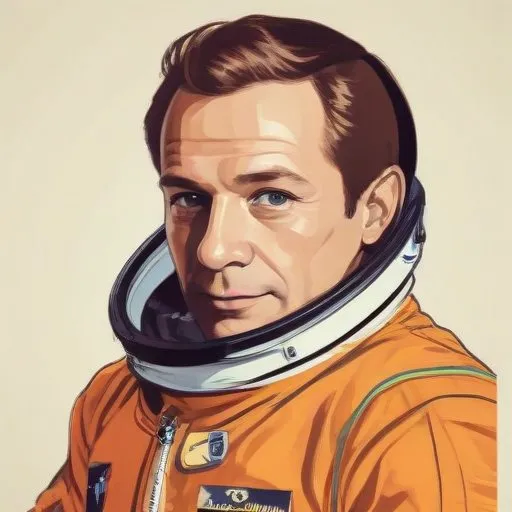
Reinhard Furrer: The Daring Physicist and Astronaut Who Defied Gravity
A life of adventure and discovery
Reinhard Furrer was a German physicist and astronaut who etched his name in the annals of space exploration history. Best known for being a payload specialist on the STS-61A D1 mission in 1985, Furrer's remarkable journey was marked by a passion for flight, a thirst for knowledge, and a spirit of adventure.
Early Life and Education
Born on November 25, 1940, in Wörgl, Austria, Furrer's life was shaped by the tumultuous times of World War II. After his father's expulsion from Austria, the family found a new home in Kempten im Allgäu, Bavaria. His curiosity and intellect led him to the University of Kiel, where he studied physics, later transferring to the Free University of Berlin to earn his diploma in 1969 and doctorate in 1972.
A Passion for Flight
Furrer's fascination with flight was more than just a hobby. He earned his pilot's license in 1974 and went on to undertake several long-distance trips, including a remarkable solo flight from Germany to Quito, Ecuador in 1981. His love for planes became an integral part of his identity, eventually leading to his selection as an astronaut.
The Astronaut Years
In 1977, Furrer applied for the first Spacelab mission, making it to the final round of candidates. Although he wasn't selected initially, he was chosen as a payload specialist for the STS-61A D1 mission in 1982, alongside
Ernst Messerschmid and
Wubbo Ockels. On October 30, 1985, he embarked on his maiden spaceflight, wearing a Sinn watchmaker model 140 S on his wrist.
Post-Spaceflight Career
After his spaceflight, Furrer returned to academia, becoming a professor and Director of the Institute of Space Sciences at the Free University of Berlin in 1987. His expertise in physics and space exploration made him a sought-after figure in the scientific community.
Personal Milestones and Key Life Events
- 1974: Earned pilot's license
- 1979: Flew over the inland ice of Greenland
- 1981: Solo flight from Germany to Quito, Ecuador
Tragic End
Furrer's love for planes ultimately led to his demise. He died in a plane crash on September 9, 1995, after a flight show. His legacy, however, continues to inspire generations of scientists, astronauts, and adventurers.
Legacy and Impact
Reinhard Furrer's remarkable journey serves as a testament to the power of human curiosity and determination. His contributions to the fields of physics and space exploration have left an indelible mark on the scientific community. As we gaze up at the stars, we remember Furrer's bravery, intellect, and unwavering passion for flight.
FAQ
What is Reinhard Furrers most notable achievement?
Reinhard Furrer is best known for being the first German citizen to fly in space, aboard the Spacelab D-1 mission in 1985.
How did Reinhard Furrers training as a physicist prepare him for space travel?
Reinhard Furrers training as a physicist prepared him well for space travel, as it provided him with a strong foundation in scientific inquiry and experimentation. His experience as a research scientist also helped him to understand the scientific goals of the Spacelab mission.
What was Reinhard Furrers role on the Spacelab D-1 mission?
Reinhard Furrer served as a payload specialist on the Spacelab D-1 mission, which was a joint German-American spaceflight mission. His role was to oversee the scientific experiments conducted on board the spacecraft.
How did Reinhard Furrers experience in space impact his life and work?
Reinhard Furrers experience in space had a profound impact on his life and work. He became an advocate for space exploration and education, and continued to work on space-related projects until his death in 1995.
What is Reinhard Furrers legacy in the field of space exploration?
Reinhard Furrers legacy in the field of space exploration is one of pioneering achievement and scientific curiosity. He paved the way for future German astronauts and continues to inspire new generations of space enthusiasts.