


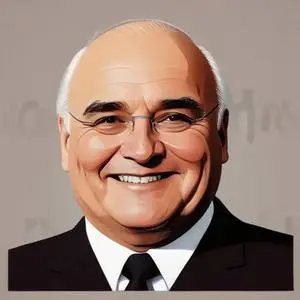
The first unified Germany's leader, who oversaw the country's reunification after the Berlin Wall's fall, and is credited with creating a strong, stable economy.
Helmut Kohl, the German politician who served as Chancellor of West Germany from 1982 to 1990 and Chancellor of Germany from 1990 to 1998, is best known for his instrumental role in ending the Cold War, reunifying Germany, and shaping the European Union (EU). With a remarkable 16-year tenure, Kohl is the longest-serving Chancellor of Germany since Otto von Bismarck, leaving an indelible mark on modern European history.
Born on April 3, 1930, in Ludwigshafen, Germany, Kohl was raised in a Catholic family. He developed an interest in politics at a young age and joined the Christian Democratic Union (CDU) in 1946, at just 16 years old. Kohl pursued higher education, earning a PhD in history from Heidelberg University in 1958. Before entering full-time politics, he worked as a business executive, gaining valuable experience that would later inform his political decisions.
Kohl's political career took off in 1959, when he became the youngest member of the Parliament of Rhineland-Palatinate. He served as minister president of the Rhineland-Palatinate state from 1969 to 1976. Initially viewed as a progressive within the CDU, Kohl's stance shifted towards a more conservative perspective as he rose through the ranks. In 1973, he was elected national chairman of the CDU, solidifying his position as a prominent figure in German politics.
In 1982, Kohl became Chancellor of West Germany through a constructive vote of no confidence, forming a coalition government with the Free Democratic Party (FDP). During his tenure, Kohl committed to European integration, fostering a strong Franco-German relationship and supporting Ronald Reagan's policies to weaken the Soviet Union. As Chancellor, Kohl chairs the G7 in 1985 and 1992, solidifying Germany's position on the global stage.
The fall of the Berlin Wall in 1989 marked a pivotal moment in Kohl's career. He seized the opportunity to reunify Germany, working closely with French President François Mitterrand to create the European Union. Kohl's decisive action led to the reunification of Germany in 1990, a testament to his vision for a united Europe.
Helmut Kohl's legacy extends far beyond his tenure as Chancellor. He played a crucial role in shaping modern Europe, earning him the nickname "the unifier." Kohl's commitment to European integration has inspired generations of politicians and policymakers. His diplomatic efforts helped to end the Cold War, and his leadership during the reunification of Germany has left an indelible mark on European history.
Throughout his career, Kohl received numerous awards and honors for his contributions to European integration and his role in shaping modern Germany.
Kohl married Hannelore Renner in 1960, and the couple had two sons, Walter and Peter. After leaving office in 1998, Kohl remained active in politics, although his health declined in later years. He passed away on June 16, 2017, leaving behind a legacy that continues to inspire and influence European politics.
72 Years Old
The first female Chancellor of Germany, serving for 16 years, known for her leadership during the European sovereign-debt crisis and her role in shaping the European Union's policy. She's a highly influential figure in modern politics.
Born in 1916
A French lawyer and politician who served as the 21st President of France, known for his socialist policies and role in shaping the European Union. He's also remembered for his controversial past and complex personality.
Born in 1925
The first female Prime Minister of the United Kingdom, serving from 1979 to 1990, known for her conservative policies and leadership during the Falklands War.
Born in 1911
The charismatic leader who championed conservative policies, helped end the Cold War, and is often credited with restoring American pride and optimism. He's also remembered for his folksy, actor-honed communication style.
Born in 1924
The 41st President of the United States, a decorated war hero and skilled diplomat, led the country through the end of the Cold War and Gulf War. He's known for his foreign policy expertise and "kinder, gentler nation" vision.
82 Years Old
The 7th Chancellor of Germany, a lawyer-turned-politician, led the country from 1998 to 2005, implementing significant economic and social reforms. He's known for his efforts to modernize Germany and strengthen the European Union.
93 Years Old
A French military officer and statesman who served as President of France from 1995 to 2007, known for his opposition to the US-led invasion of Iraq and his efforts to strengthen the European Union.
73 Years Old
The former Prime Minister of the United Kingdom who led the country through a transformative period, including the Iraq War, and is known for his charismatic leadership and controversial decisions.
