


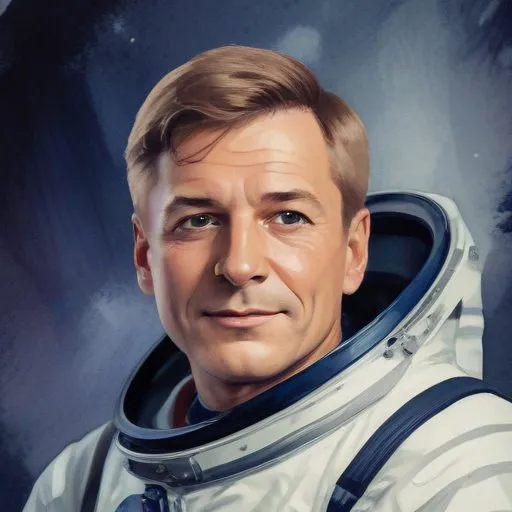
German physicist and astronaut who flew on the STS-61-A Spacelab mission in 1985, conducting scientific experiments in space. Known for being the first West German citizen in space.
Ernst Messerschmid is a renowned German physicist and former astronaut who made history by becoming one of the first Germans in space. As a payload specialist on the STS61-A mission in 1985, Messerschmid spent over 168 hours in space, solidifying his position as a pioneer in the field of astronautics.
Messerschmid was born on May 21, 1945, in Reutlingen, Germany. He completed his secondary education at the Technisches Gymnasium in Stuttgart in 1965. After serving in the military for two years, Messerschmid went on to study physics at the University of Tübingen and Bonn, earning a Diplom degree in 1972 and a doctorate in 1976.
During his academic career, Messerschmid worked as a visiting scientist at CERN in Geneva, where he focused on proton beams in accelerators and plasmas. He also worked at the University of Freiburg and the Brookhaven National Laboratory in New York. In 1977, he joined DESY in Hamburg, where he contributed to the development of the PETRA storage ring.
In 1978, Messerschmid began working at the DFVLR (the precursor to the DLR) in the Institute of Communications Technology in Oberpfaffenhofen, where he focused on spaceborne communications. This experience laid the foundation for his future work in space exploration.
In 1983, Messerschmid was selected as one of the astronauts for the first German Spacelab mission, D1. This led to his historic spaceflight on STS61-A in 1985, where he spent over 168 hours in space. After his spaceflight, Messerschmid became a professor at the Institut für Raumfahrtsysteme at the University of Stuttgart, where he taught astronautics and space stations.
From 2000 to 2004, Messerschmid served as the head of the European Astronaut Centre in Cologne. He later returned to the University of Stuttgart, where he continued to teach and conduct research in astronautics and space stations. Throughout his career, Messerschmid has made significant contributions to the field of space exploration, inspiring future generations of scientists and astronauts.
Ernst Messerschmid's remarkable journey from a small town in Germany to the vast expanse of space is a testament to human curiosity and determination. His groundbreaking work in astronautics and space stations continues to inspire and educate, leaving a lasting impact on the world of space exploration.
85 Years Old
First European astronaut in space, conducting Spacelab experiments on the Space Shuttle. Known for his scientific contributions to space research.
99 Years Old
A German statesman who served as Vice-Chancellor and Foreign Minister, playing a key role in reunifying Germany and shaping European politics. He's known for his diplomatic efforts and advocacy for human rights.
85 Years Old
Physicist and astronaut who flew on the Spacelab D-2 mission in 1985, conducting scientific experiments in space. He was the first German citizen in space.
Born in 1894
Pioneering rocket scientist and space travel theorist who laid the groundwork for modern astronautics, inspiring generations of space enthusiasts.
Born in 1912
Developed the V-2 rocket for Nazi Germany and later led the team that created the Saturn V rocket that took humans to the moon.
