


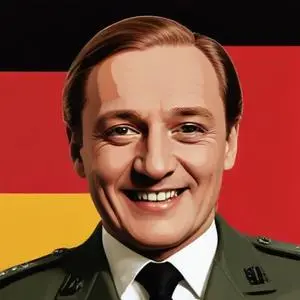
A German statesman who served as Vice-Chancellor and Foreign Minister, playing a key role in reunifying Germany and shaping European politics. He's known for his diplomatic efforts and advocacy for human rights.
Hans-Dietrich Genscher, the veteran German statesman, is widely regarded as the principal architect of German reunification. Throughout his illustrious career, he served as Federal Minister of the Interior, Federal Minister for Foreign Affairs, and Vice Chancellor of Germany, making him the longest-serving occupant of either post.
Genscher was born on 21 March 1927 in Reideburg, Province of Saxony, which later became part of East Germany. His father, a lawyer, passed away when Genscher was just nine years old. In 1943, he was drafted to serve as a member of the Air Force Support Personnel at the age of 16. Close to the end of World War II, he and his fellow soldiers became members of the Nazi Party due to a collective application by his Wehrmacht unit, a decision he later regretted.
After the war, Genscher studied law and became a member of the liberal Free Democratic Party (FDP). He quickly rose through the ranks, becoming a close ally of Chancellor Helmut Schmidt. In 1969, he was appointed Federal Minister of the Interior, a post he held until 1974. He then served as Federal Minister for Foreign Affairs and Vice Chancellor of Germany, a position he held from 1974 to 1992, with a brief two-week break in 1982.
Under his leadership, Germany played a crucial role in shaping European politics, and Genscher was instrumental in negotiating several key treaties, including the Helsinki Accords and the NATO Double-Track Decision.
In 1991, he chaired the Organization for Security and Cooperation in Europe (OSCE) and played a pivotal role in international diplomacy surrounding the breakup of Yugoslavia, pushing for the recognition of Croatia, Slovenia, and other republics declaring independence.
He was a strong proponent of Realpolitik, earning him the reputation as a master of diplomacy.
After leaving office, Genscher worked as a lawyer and international consultant. He remained active in politics, serving as President of the German Council on Foreign Relations and participating in various international organizations. One of his notable initiatives was his call for a Cold War museum to be built in Berlin, alongside former Czech President Václav Havel.
Hans-Dietrich Genscher's legacy is one of diplomacy, statesmanship, and a deep commitment to European unity. His efforts towards German reunification and his role in shaping European politics have left an indelible mark on history. He will be remembered as one of the most influential German politicians of the 20th century.
Genscher passed away on 31 March 2016, leaving behind a legacy that continues to inspire generations of politicians, diplomats, and citizens alike.
96 Years Old
The first unified Germany's leader, who oversaw the country's reunification after the Berlin Wall's fall, and is credited with creating a strong, stable economy.
82 Years Old
The 7th Chancellor of Germany, a lawyer-turned-politician, led the country from 1998 to 2005, implementing significant economic and social reforms. He's known for his efforts to modernize Germany and strengthen the European Union.
72 Years Old
The first female Chancellor of Germany, serving for 16 years, known for her leadership during the European sovereign-debt crisis and her role in shaping the European Union's policy. She's a highly influential figure in modern politics.
Born in 1915
A prominent post-war German politician who served as Minister President of Bavaria and played a key role in shaping the country's conservative politics. He was also a strong advocate for European integration.
Born in 1913
A German statesman who served as Chancellor of Germany, known for his efforts to reconcile with Eastern Europe and his "Ostpolitik" policy, earning him a Nobel Peace Prize.
Born in 1876
Led post-war West Germany's reconstruction and served as a key figure in shaping the country's modern identity, earning him the title "Father of the Federal Republic."
Born in 1918
A German leader who served as Chancellor from 1974 to 1982, known for his pragmatic and socially liberal policies, and his key role in shaping the European Union. He was also a respected economist and published author.
95 Years Old
The last leader of the Soviet Union, who introduced reforms that led to the end of the Cold War and the collapse of communism, earning a Nobel Peace Prize. He's known for his policies of glasnost and perestroika, which transformed the Soviet Union and the world.
