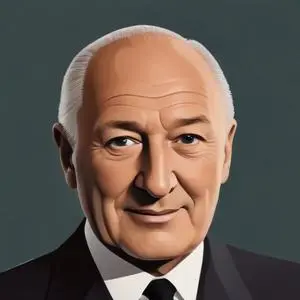
Konrad Adenauer: The Founding Father of Modern Germany
Chancellor of the Federal Republic of Germany
Konrad Adenauer is renowned as the first Chancellor of the Federal Republic of Germany, serving from 1949 to 1963, and the first leader of the Christian Democratic Union (CDU), which became the dominant force in the country under his leadership. During his tenure, he worked tirelessly to restore the West German economy, establishing the country as a central player in European politics and a beacon of liberal democracy.
Early Life and Education
Born on January 5, 1876, in Cologne, Germany, Adenauer was the third of five children to Johann Konrad Adenauer and his wife Helene. He studied law and politics at the University of Freiburg, the University of Munich, and the University of Berlin, earning a doctorate in law in 1901.
Political Career
Adenauer's political career spanned over six decades, beginning in 1904 when he was appointed as a lawyer for the city of Cologne. He served as Mayor of Cologne from 1917 to 1933 and as president of the Prussian State Council. During the Weimar Republic, he was a leading politician of the Catholic Centre Party.
Rise to Prominence
In the aftermath of World War II, Adenauer switched focus from denazification to recovery, leading his country to close relations with France, the United Kingdom, and the United States. He was instrumental in establishing the Federal Republic of Germany and played a crucial role in shaping the country's post-war identity.
Foreign Policy and European Unity
Adenauer was a strong anticommunist and a driving force behind an Atlanticist foreign policy. He worked to reestablish national military forces, the Bundeswehr, and intelligence services, the Bundesnachrichtendienst, in West Germany. In 1955, West Germany joined NATO, and in 1957, Adenauer signed the Treaty of Rome, cementing his commitment to European unity.
Legacy
Adenauer's legacy extends far beyond his tenure as Chancellor. He is remembered as one of the Founding Fathers of the European Union, and his commitment to European unity and liberal democracy continues to shape the continent's politics. His leadership played a significant role in West Germany's economic prosperity, earning him the nickname "Der Alte" (The Old Man).
Personal Life and Milestones
Adenauer was a devout Roman Catholic and a strong family man. He married Emma Weyer in 1904, and they had three children together. He outlived his wife, who passed away in 1916, and remarried in 1935 to Auguste Zinser.
Quotes and Memorable Sayings
- "Germany's fate is inextricably linked with that of Europe."
- "The West German economy is not just a matter of economics, but a matter of politics and morals."
Historical Context and Legacy
Adenauer's life and legacy are inextricably linked with the tumultuous history of 20th-century Germany. His leadership played a significant role in shaping the country's post-war identity and establishing it as a central player in European politics. As a champion of liberal democracy and European unity, his legacy continues to shape the continent's politics to this day.
Awards and Honors
Adenauer received numerous awards and honors for his contributions to European unity and liberal democracy, including the Charlemagne Prize in 1954 and the Grand Cross of the Order of Merit of the Federal Republic of Germany in 1955.
FAQ
What was Konrad Adenauers role in post-war Germany?
Konrad Adenauer played a crucial role in post-war Germany, serving as the first Chancellor of West Germany from 1949 to 1963 and leading the country through a period of reconstruction and economic growth.
What was Adenauers stance on European integration?
Konrad Adenauer was a strong advocate for European integration, believing that a united Europe would ensure peace and stability on the continent. He played a key role in the formation of the European Coal and Steel Community, a precursor to the European Union.
What was Adenauers relationship with France?
Konrad Adenauer maintained a close relationship with France, working closely with French leaders to strengthen European cooperation and promote reconciliation between Germany and France.
What were Adenauers domestic policies?
Konrad Adenauers domestic policies focused on rebuilding the German economy, promoting social welfare, and supporting small and medium-sized businesses. He also played a key role in drafting the German Basic Law, the countrys constitution.
What was Adenauers role in the formation of NATO?
Konrad Adenauer was a strong supporter of the North Atlantic Treaty Organization (NATO) and played a key role in its formation in 1949, recognizing the importance of a collective defense alliance for Western Europe.