


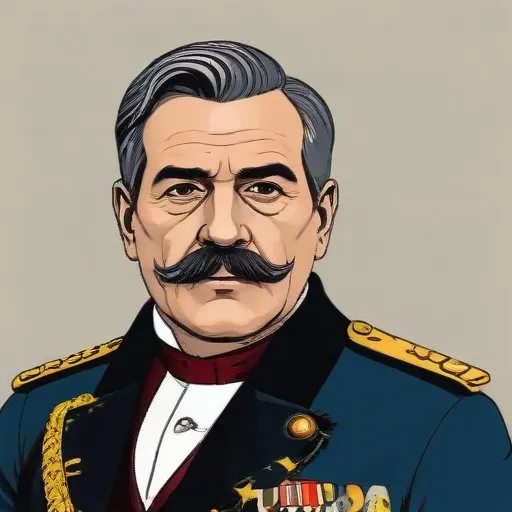
A prominent post-war German politician who served as Minister President of Bavaria and played a key role in shaping the country's conservative politics. He was also a strong advocate for European integration.
Franz Josef Strauss is widely credited as the cofounder of European aerospace conglomerate Airbus, a testament to his innovative spirit and vision for European integration. As a German politician, he left an indelible mark on the country's politics, serving as the longtime chairman of the Christian Social Union (CSU) in Bavaria from 1961 until 1988.
Born on September 6, 1915, in Munich, Strauss was the second child of a butcher. He studied German letters, history, and economics at the Ludwig Maximilian University of Munich from 1935 to 1939.
Strauss served in the Wehrmacht on the Western and Eastern Fronts during World War II. While on furlough, he passed the German state exams to become a teacher. After suffering from severe frostbite on the Eastern Front in early 1943, he served as an Offizier für wehrgeistige Führung, responsible for the education of the troops, at the antiaircraft artillery school in Altenstadt Air Base, near Schongau. He held the rank of Oberleutnant at the end of the war.
In 1945, he served as a translator for the U.S. Army. He began using his middle name Josef soon after the war. After the war, Strauss' political career took off. He was appointed deputy Landrat (chief executive) and later became a member of the federal cabinet in different positions between 1953 and 1969.
Strauss is remembered for his significant contributions to European integration and his role in shaping Germany's politics. He was a strong advocate for European cooperation and played a key role in the formation of Airbus, which has become a symbol of European industrial cooperation. As minister-president of the state of Bavaria from 1978 until 1988, Strauss worked tirelessly to promote economic growth and development in the region.
Strauss' legacy extends beyond his political career. He played a significant role in shaping Germany's post-war identity and promoting European integration. His vision for a united Europe has inspired generations of politicians and continues to influence European politics today.
"The European idea is not a vague notion, but a concrete reality that has already been achieved in many areas of our lives."
"We must not let ourselves be driven by the winds of history, but rather learn to navigate them."
By capturing the essence of Franz Josef Strauss' life and achievements, we can gain a deeper understanding of the complex and dynamic world of European politics and the lasting impact of his vision on modern society.
96 Years Old
The first unified Germany's leader, who oversaw the country's reunification after the Berlin Wall's fall, and is credited with creating a strong, stable economy.
Born in 1876
Led post-war West Germany's reconstruction and served as a key figure in shaping the country's modern identity, earning him the title "Father of the Federal Republic."
Born in 1897
The second Chancellor of West Germany, a key figure in the country's post-war economic miracle, known for his liberal economic policies and leadership during a period of rapid growth and reconstruction.
Born in 1904
A German lawyer and politician who served as Chancellor of Germany from 1966 to 1969, known for his role in rebuilding post-war Germany and his efforts to come to terms with the country's Nazi past.
99 Years Old
A German statesman who served as Vice-Chancellor and Foreign Minister, playing a key role in reunifying Germany and shaping European politics. He's known for his diplomatic efforts and advocacy for human rights.
84 Years Old
A German lawyer and politician who served as Minister President of Bavaria, known for his conservative policies and efforts to strengthen regional autonomy. He played a key role in shaping Bavaria's economy and politics.
