


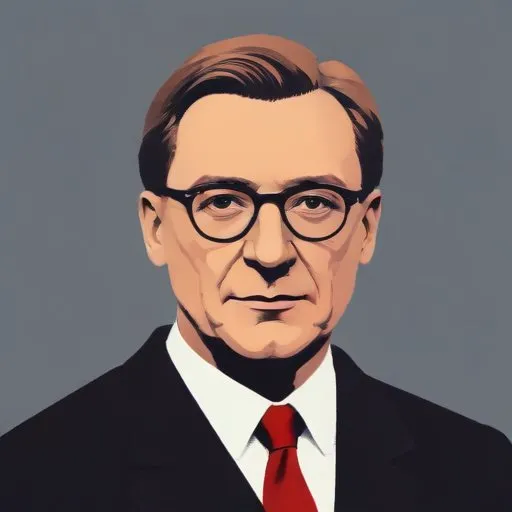
A German lawyer and politician who served as Chancellor of Germany from 1966 to 1969, known for his role in rebuilding post-war Germany and his efforts to come to terms with the country's Nazi past.
Kurt Georg Kiesinger, the towering figure of post-war German politics, is renowned for his remarkable tenure as the Chancellor of West Germany from 1966 to 1969. As the leader of the Christian Democratic Union (CDU), he forged a grand coalition with Willy Brandt's Social Democratic Party (SPD), marking a significant milestone in German history.
Born on April 6, 1904, in Ebingen, Kingdom of Württemberg (now Albstadt, Baden-Württemberg), Kiesinger's early life was shaped by the tumultuous landscape of Germany during World War I and the subsequent rise of the Nazi Party. In 1933, he gained his law certificate and briefly worked as a lawyer in Berlin's Kammergericht court before joining the Nazi Party.
Although Kiesinger's involvement with the Nazi Party remains a controversial aspect of his career, he claimed to have been a largely inactive member. To avoid conscription, he was appointed to the broadcast policy department of the Foreign Office by Joachim von Ribbentrop in 1940, where he became deputy head of the broadcasting and propaganda departments in 1942.
After the war, Kiesinger's political career took off as he joined the Christian Democratic Union (CDU) in 1946. He was elected to the Bundestag in 1949 and remained a member until 1958, when he became the Minister-President of Baden-Württemberg, a position he held until 1966.
During his tenure as Minister-President, Kiesinger founded the universities of Konstanz and Ulm, showcasing his commitment to education and regional development. His impressive leadership skills and oratory mastery earned him the nickname "Chief Silver Tongue."
In 1966, Kiesinger's grand coalition with the SPD propelled him to the Chancellorship of West Germany, a position he held until 1969. His leadership was marked by significant economic growth, social reform, and a commitment to European integration.
Kiesinger's association with the Nazi Party has been a subject of controversy throughout his career. The student movement of the 1960s, in particular, viewed him as a symbol of Germany's failure to come to terms with its past. Despite this, Kiesinger's remarkable political acumen, oratory skills, and commitment to regional development have left an indelible mark on German history.
Kiesinger was an accomplished author of poetry and various books, showcasing his literary prowess. He remained a member of the Bundestag until 1980, demonstrating his dedication to public service. Through his career, Kiesinger's philosophical contributions emphasized the importance of coalition-building, regional development, and education.
Kurt Georg Kiesinger's remarkable journey, marked by both triumph and controversy, has cemented his place as one of the most influential figures in post-war German politics.
Born in 1876
Led post-war West Germany's reconstruction and served as a key figure in shaping the country's modern identity, earning him the title "Father of the Federal Republic."
Born in 1897
The second Chancellor of West Germany, a key figure in the country's post-war economic miracle, known for his liberal economic policies and leadership during a period of rapid growth and reconstruction.
Born in 1913
A German statesman who served as Chancellor of Germany, known for his efforts to reconcile with Eastern Europe and his "Ostpolitik" policy, earning him a Nobel Peace Prize.
Born in 1918
A German leader who served as Chancellor from 1974 to 1982, known for his pragmatic and socially liberal policies, and his key role in shaping the European Union. He was also a respected economist and published author.
96 Years Old
The first unified Germany's leader, who oversaw the country's reunification after the Berlin Wall's fall, and is credited with creating a strong, stable economy.
82 Years Old
The 7th Chancellor of Germany, a lawyer-turned-politician, led the country from 1998 to 2005, implementing significant economic and social reforms. He's known for his efforts to modernize Germany and strengthen the European Union.
72 Years Old
The first female Chancellor of Germany, serving for 16 years, known for her leadership during the European sovereign-debt crisis and her role in shaping the European Union's policy. She's a highly influential figure in modern politics.
Born in 1915
A prominent post-war German politician who served as Minister President of Bavaria and played a key role in shaping the country's conservative politics. He was also a strong advocate for European integration.
