


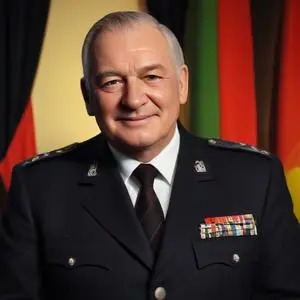
The second Chancellor of West Germany, a key figure in the country's post-war economic miracle, known for his liberal economic policies and leadership during a period of rapid growth and reconstruction.
Ludwig Erhard is widely regarded as the mastermind behind West Germany's post-war economic reforms and recovery, earning him the title of 'Chancellor of the Economic Miracle' (Wirtschaftswunder). As Minister of Economic Affairs under Chancellor Konrad Adenauer from 1949 to 1963, Erhard's concept of the social market economy (soziale Marktwirtschaft) laid the foundation for Germany's economic policy in the 21st century.
Born on February 4, 1897, in Fürth, Kingdom of Bavaria, Erhard's early life was marked by adversity. At the age of three, he contracted infantile paralysis, which left him with a deformed right foot and required him to wear orthopedic shoes for the rest of his life.
Despite these challenges, Erhard pursued his education, entering primary school in Fürth at the age of six. He later attended the Royal Bavarian Vocational High School, where he achieved average grades. After receiving his secondary school certificate in 1913, Erhard began a commercial apprenticeship at the Georg Eisenbach textile company in Nuremberg, which lasted until 1916.
In 1916, Erhard volunteered for military service, serving in the German Army during World War I. After the war, he enrolled at the University of Frankfurt, where he studied economics, earning his Ph.D. in 1925.
Erhard's political career began in 1949, when he was appointed Minister of Economic Affairs under Chancellor Konrad Adenauer. During his tenure, he introduced radical economic reforms, including the abolition of price controls, the introduction of a new currency (Deutsche Mark), and the promotion of free market principles.
In 1963, Erhard succeeded Adenauer as Chancellor of West Germany, a position he held until 1966. Although he faced challenges during his tenure, including a budget deficit and public criticism of his foreign policy, Erhard's legacy as the architect of West Germany's economic miracle remains unchallenged.
Erhard's concept of the social market economy was rooted in his belief that economic freedom and social welfare are intertwined. He advocated for a balance between free market principles and social responsibility, which he believed would lead to greater prosperity and social justice.
Ludwig Erhard's impact on modern Germany is still felt today. His economic reforms and concept of the social market economy have inspired generations of economists and policymakers. His legacy extends beyond Germany, as his ideas have influenced economic policy around the world.
Born in 1876
Led post-war West Germany's reconstruction and served as a key figure in shaping the country's modern identity, earning him the title "Father of the Federal Republic."
Born in 1913
A German statesman who served as Chancellor of Germany, known for his efforts to reconcile with Eastern Europe and his "Ostpolitik" policy, earning him a Nobel Peace Prize.
Born in 1918
A German leader who served as Chancellor from 1974 to 1982, known for his pragmatic and socially liberal policies, and his key role in shaping the European Union. He was also a respected economist and published author.
96 Years Old
The first unified Germany's leader, who oversaw the country's reunification after the Berlin Wall's fall, and is credited with creating a strong, stable economy.
Born in 1915
A prominent post-war German politician who served as Minister President of Bavaria and played a key role in shaping the country's conservative politics. He was also a strong advocate for European integration.
99 Years Old
A German statesman who served as Vice-Chancellor and Foreign Minister, playing a key role in reunifying Germany and shaping European politics. He's known for his diplomatic efforts and advocacy for human rights.
