


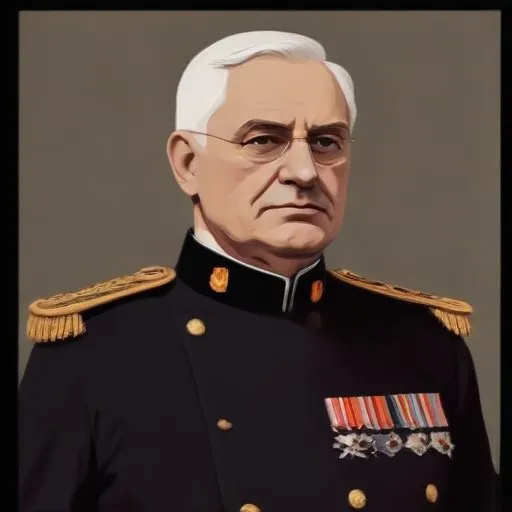
A German military officer turned politician who served as the President of West Germany from 1979 to 1984, known for his conservative policies and efforts to strengthen the country's economy. He played a key role in shaping Germany's post-war identity and foreign policy.
Karl Carstens, a name synonymous with German politics, served as the president of West Germany from 1979 to 1984. As a prominent figure in post-war Germany, Carstens left an indelible mark on the country's political landscape.
Born on December 14, 1914, in the city of Bremen, Carstens' life was shaped by the turmoil of World War I. His father, a commercial school teacher, was killed at the Western Front shortly before his birth. This early loss instilled in Carstens a sense of resilience and determination that would define his future.
Carstens pursued higher education with zeal, studying law and political science at the universities of Frankfurt, Dijon, Munich, Königsberg, and Hamburg between 1933 and 1936. He earned his doctorate in 1938 and took the Second Staatsexamen degree in 1939. In 1949, he also received a Master of Laws (LL.M.) degree from Yale Law School, a testament to his intellectual curiosity.
During World War II, Carstens served as a member of an antiaircraft artillery Flak unit in the Luftwaffe, rising to the rank of Leutnant (Second Lieutenant) by the war's end. In 1940, he joined the Nazi Party, reportedly to avoid detrimental treatment while working as a law clerk. Earlier, in 1934, he had joined the Nazi SA paramilitary organization.
In 1944, Carstens married medical student Veronica Prior in Berlin. After the war, he established himself as a lawyer in Bremen and became a councillor of the city's Senate in 1949. He also worked as a lecturer at the University of Cologne, where he habilitated in 1950.
In 1954, Carstens joined the diplomatic service of the German Foreign Office, serving as West Germany's representative at the Council of Europe in Strasbourg. He became a member of the Christian Democratic Union (CDU) under Chancellor Konrad Adenauer in 1955. By 1960, he had risen to the position of secretary of state at the Foreign Office and was appointed professor for public and international law at the University of Cologne.
Carstens' political acumen and diplomatic experience paved the way for his presidency of West Germany from 1979 to 1984. During his tenure, he worked to strengthen Germany's ties with European neighbors and the United States, cementing his reputation as a skilled statesman.
Through his life, Karl Carstens demonstrated an unwavering commitment to public service, navigating the complexities of post-war Germany with integrity and vision. His legacy serves as a testament to the power of resilience, education, and dedication in shaping the course of a nation's history.
Born in 1918
A German leader who served as Chancellor from 1974 to 1982, known for his pragmatic and socially liberal policies, and his key role in shaping the European Union. He was also a respected economist and published author.
Born in 1913
A German statesman who served as Chancellor of Germany, known for his efforts to reconcile with Eastern Europe and his "Ostpolitik" policy, earning him a Nobel Peace Prize.
82 Years Old
The 7th Chancellor of Germany, a lawyer-turned-politician, led the country from 1998 to 2005, implementing significant economic and social reforms. He's known for his efforts to modernize Germany and strengthen the European Union.
72 Years Old
The first female Chancellor of Germany, serving for 16 years, known for her leadership during the European sovereign-debt crisis and her role in shaping the European Union's policy. She's a highly influential figure in modern politics.
Born in 1915
A prominent post-war German politician who served as Minister President of Bavaria and played a key role in shaping the country's conservative politics. He was also a strong advocate for European integration.
Born in 1904
A German lawyer and politician who served as Chancellor of Germany from 1966 to 1969, known for his role in rebuilding post-war Germany and his efforts to come to terms with the country's Nazi past.
Born in 1897
The second Chancellor of West Germany, a key figure in the country's post-war economic miracle, known for his liberal economic policies and leadership during a period of rapid growth and reconstruction.
Born in 1876
Led post-war West Germany's reconstruction and served as a key figure in shaping the country's modern identity, earning him the title "Father of the Federal Republic."
