


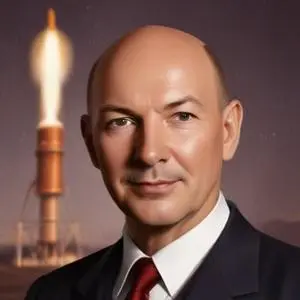
Pioneering rocket scientist who developed and launched the world's first liquid-fueled rocket, paving the way for modern space exploration.
Robert H. Goddard is credited with creating and building the world's first liquid-fueled rocket, which was successfully launched on March 16, 1926. By 1915, his pioneering work had dramatically improved the efficiency of the solid-fueled rocket, signaling the era of modern rocketry and innovation.
Robert Hutchings Goddard was born on October 5, 1882, in Worcester, Massachusetts. He showed an early interest in science and technology, which was encouraged by his parents. Goddard earned his Bachelor's degree in physics from Worcester Polytechnic Institute in 1908 and went on to earn his Master's and Ph.D. degrees from Clark University in 1910 and 1911, respectively.
Goddard's work as both a theorist and engineer anticipated many of the developments that would make spaceflight possible. He held 214 patents, including two critical inventions: a multistage rocket (1914) and a liquid-fuel rocket (1914). His 1919 monograph, "A Method of Reaching Extreme Altitudes," is considered one of the classic texts of 20th-century rocket science.
Despite his groundbreaking work, Goddard received little public support, moral or monetary, for his research and development work. The press and other scientists ridiculed his theories of spaceflight, and he became protective of his privacy and work.
Years after his death, at the dawn of the Space Age, Goddard came to be recognized as one of the founding fathers of modern rocketry, along with Robert Esnault-Pelterie, Konstantin Tsiolkovsky, and Hermann Oberth. He not only recognized early on the potential of rockets for atmospheric research, ballistic missiles, and space travel but also was the first to scientifically study, design, construct, and fly them.
Goddard's legacy extends far beyond his own lifetime. He has been awarded numerous honors, including the Congressional Space Medal of Honor in 1961. The Goddard Space Flight Center in Greenbelt, Maryland, was named in his honor in 1959.
Robert H. Goddard's pioneering work in rocketry paved the way for the Space Age, and his influence can still be felt today. His story serves as an inspiration to scientists, engineers, and innovators around the world.
Born in 1912
Developed the V-2 rocket for Nazi Germany and later led the team that created the Saturn V rocket that took humans to the moon.
Born in 1907
A pioneering rocket engineer and designer who played a crucial role in the Soviet space program, developing the R-7 rocket that launched Sputnik and sent humans into space.
Born in 1857
Pioneering rocket scientist and engineer who developed the theoretical foundations of modern astronautics, including the concept of multistage rockets and space exploration.
Born in 1894
Pioneering rocket scientist and space travel theorist who laid the groundwork for modern astronautics, inspiring generations of space enthusiasts.
96 Years Old
First person to walk on the Moon during the Apollo 11 mission, marking a historic milestone in space exploration.
96 Years Old
Second man to walk on the Moon during the Apollo 11 mission, a pioneering astronaut and advocate for space exploration.
75 Years Old
American physicist and astronaut who broke barriers as the first woman in space, inspiring generations of women in STEM fields. Founded a company to promote science education and literacy.
98 Years Old
American baseball player who pitched in the Major Leagues from 1965 to 1975, known for being a four-time All-Star and winning the American League ERA title in 1968.
