


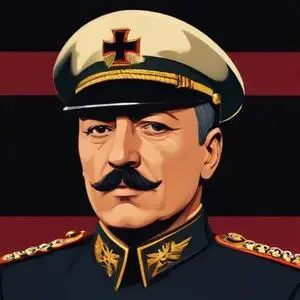
A German general and politician who played a crucial role in World War I, masterminding the 1918 Spring Offensive and later promoting Nazi ideology.
Erich Ludendorff, a German military officer and politician, is best known for his pivotal role in the German victories during World War I, particularly the Battle of Liège and the Battle of Tannenberg. As the chief policymaker in a de facto military dictatorship, Ludendorff's strategic brilliance and unwavering dedication to the German war effort earned him both fame and notoriety.
Born on April 9, 1865, in Kruszewnia, Prussian Province of Posen, Ludendorff hailed from a family of minor nobility. After completing his education as a cadet, he was commissioned as a junior officer in 1885. His exceptional talent and ambition soon propelled him to the prestigious German War Academy, where he was admitted in 1893.
Ludendorff's star continued to rise as he rapidly advanced in rank, becoming a member of the Army's Great General Staff by 1904. Although he was temporarily removed from the Great General Staff for meddling in politics, his success as a commander in World War I restored his standing in the army. The successful German assault on Liège in August 1914 earned him the Pour le Mérite, one of Germany's highest military honors.
On the Eastern Front, Ludendorff played a crucial role in inflicting a series of crushing defeats against the Russians, including the Battle of Tannenberg and the Battle of the Masurian Lakes. His strategic prowess and ability to mobilize troops earned him recognition as one of Germany's most skilled military minds.
By August 1916, Ludendorff had successfully lobbied for General Paul von Hindenburg's appointment as Supreme Commander, as well as his own promotion to First Quartermaster General. This marked the beginning of a de facto military dictatorship, with Ludendorff directing Germany's entire military strategy and war effort until the end of the conflict.
Following Germany's defeat, Ludendorff became embroiled in the country's political turmoil. He took part in the failed 1920 Kapp Putsch and Hitler's 1923 Beer Hall Putsch, which ultimately led to his estrangement from the German army and society. Ludendorff's later years were marked by controversy and public perception of his role in the Nazi rise to power.
Erich Ludendorff's legacy is complex and multifaceted. While his military genius and leadership are undeniable, his involvement in right-wing politics and associations with the Nazi party have tarnished his reputation. Nevertheless, his contributions to German military strategy and his role in shaping the course of World War I remain significant and thought-provoking.
Ludendorff's life and career serve as a fascinating case study of the intricate relationships between politics, war, and society. His story continues to captivate historians and military enthusiasts alike, offering valuable insights into the complexities of human conflict and the nature of leadership.
Born in 1847
A German field marshal and politician who served as the 2nd President of Germany during the Weimar Republic, playing a crucial role in the rise of the Nazi Party. He's infamous for appointing Adolf Hitler as Chancellor of Germany in 1933.
Born in 1889
The dictator of Nazi Germany, responsible for the genocide of six million Jews and millions of other people during World War II, and infamous for his extreme nationalist and anti-Semitic ideology.
Born in 1900
Leading the SS and Gestapo, he oversaw the Nazi regime's brutal security apparatus and implemented the "Final Solution," orchestrating the genocide of six million Jews during World War II.
Born in 1893
A high-ranking Nazi official, he was a decorated World War I fighter pilot and later became a prominent politician, serving as Minister President of Prussia. He's infamous for his role in the Nazi regime and war crimes trials.
Born in 1897
A mastermind of Nazi propaganda, he crafted a persuasive narrative that fueled the Third Reich's rise to power, leaving a lasting impact on the world.
Born in 1894
A high-ranking Nazi official who flew to Scotland on a solo mission to negotiate peace with the UK, but was instead arrested and imprisoned.
Born in 1893
A German diplomat who served as the Nazi regime's Foreign Minister, orchestrating key alliances and treaties that led to World War II. He was a close associate of Adolf Hitler and played a crucial role in shaping Nazi foreign policy.
Born in 1879
A German nobleman who served as Chancellor of Germany in 1932, known for his role in appointing Adolf Hitler as Chancellor, paving the way for the Nazi regime.
