


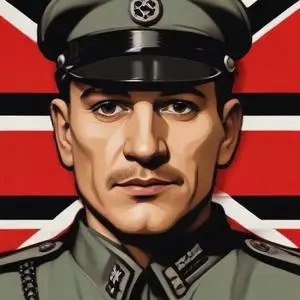
A high-ranking Nazi official who played a key role in the party's early development and was a close ally of Adolf Hitler, but was eventually purged and executed during the Night of the Long Knives. He's infamous for his leadership of the Sturmabteilung (SA) paramilitary group.
Ernst Rhm, a German military officer and politician, is most famously known for being the co-founder and leader of the Sturmabteilung (SA), the original paramilitary wing of the Nazi Party, which played a pivotal role in Adolf Hitler's rise to power.
Rhm's association with Hitler and the Nazi Party dates back to 1919, when he joined the German Workers' Party, the precursor to the Nazi Party. Using his military connections, he helped build up several paramilitary groups in service of Hitler, one of which became the SA.
Born on November 28, 1887, in Munich, Rhm joined the Imperial German Army in 1906 and fought in World War I, where he was wounded in action three times and received the Iron Cross First Class.
After the war, he continued his military career as a captain in the Reichswehr and provided assistance to Franz Ritter von Epp's Freikorps.
In 1923, Rhm took part in Hitler's failed Beer Hall Putsch to seize governmental power in Munich and was given a suspended prison sentence.
In 1930, at Hitler's request, Rhm returned to Germany and was officially appointed chief of staff of the SA in 1931. Under his leadership, the SA grew to over a million members and continued its campaign of political violence against communists, rival political parties, Jews, and other groups deemed hostile to the Nazi agenda.
Rhm's homosexuality, which gradually became public knowledge, sparked opposition to him within the party. Despite this, he retained Hitler's trust for a time.
However, in 1934, Hitler ordered the execution of Rhm and many other high-ranking SA officials during the Night of the Long Knives, a purge of perceived political threats.
Rhm's legacy is complex and multifaceted. While he played a significant role in Hitler's rise to power and the growth of the Nazi Party, his own personal beliefs and loyalties are shrouded in mystery.
Despite his controversial legacy, Rhm remains an important figure in the history of the Nazi Party and a testament to the complexities of human nature.
Rhm's story serves as a cautionary tale of the dangers of blind allegiance and the corrupting influence of power.
His legacy serves as a reminder of the importance of understanding the complexities of human nature and the importance of critically evaluating the actions of those in power.
Born in 1889
The dictator of Nazi Germany, responsible for the genocide of six million Jews and millions of other people during World War II, and infamous for his extreme nationalist and anti-Semitic ideology.
Born in 1893
A high-ranking Nazi official, he was a decorated World War I fighter pilot and later became a prominent politician, serving as Minister President of Prussia. He's infamous for his role in the Nazi regime and war crimes trials.
Born in 1897
A mastermind of Nazi propaganda, he crafted a persuasive narrative that fueled the Third Reich's rise to power, leaving a lasting impact on the world.
Born in 1900
Leading the SS and Gestapo, he oversaw the Nazi regime's brutal security apparatus and implemented the "Final Solution," orchestrating the genocide of six million Jews during World War II.
Born in 1894
A high-ranking Nazi official who flew to Scotland on a solo mission to negotiate peace with the UK, but was instead arrested and imprisoned.
Born in 1893
A German diplomat who served as the Nazi regime's Foreign Minister, orchestrating key alliances and treaties that led to World War II. He was a close associate of Adolf Hitler and played a crucial role in shaping Nazi foreign policy.
Born in 1907
Leader of the Hitler Youth organization during World War II, responsible for indoctrinating and recruiting millions of young Germans into the Nazi Party.
Born in 1891
A German naval commander who led the U-boat fleet during World War II and briefly served as President of Germany after Hitler's death, known for his role in the war and its aftermath.
