


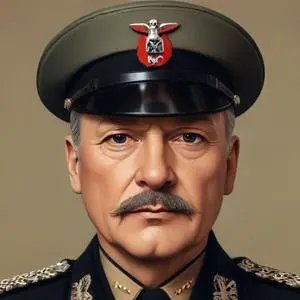
A high-ranking Nazi officer who served as the Chief of the OKW, the German High Command, during World War II, and was known for his unwavering loyalty to Hitler. He was tried and executed for war crimes after the war.
Wilhelm Keitel, a German field marshal, held the office of Chief of the Oberkommando der Wehrmacht (OKW), the high command of Nazi Germany's armed forces, during World War II. He signed numerous criminal orders and directives that led to various war crimes, earning him the reputation as one of the most reviled figures of the war.
Born on September 22, 1882, in Helmscherode, Duchy of Brunswick, Germany, Keitel was the eldest son of Carl Keitel, a middle-class landowner, and his wife Apollonia Vissering. Initially, he wanted to take over his family's estates, but his father's reluctance to retire led him to pursue a military career instead.
Keitel's rise to the Wehrmacht high command began with his appointment as the head of the Armed Forces Office at the Reich Ministry of War in 1935. When Adolf Hitler replaced the ministry with the OKW in 1938, Keitel became its chief, solidifying his position as one of Hitler's closest military advisors.
Keitel's tenure as Chief of the OKW was marked by his signing of numerous criminal orders and directives, including the notorious "Commissar Order" and the "Night and Fog Decree," which led to the persecution and murder of millions of innocent civilians and prisoners of war.
Sentenced to death, Keitel was executed by hanging on October 16, 1946. His legacy is forever marred by his complicity in the atrocities committed during World War II, serving as a stark reminder of the dangers of blind loyalty and obedience to authority.
Today, Wilhelm Keitel's name is synonymous with the darkest aspects of human nature, a cautionary tale of the devastating consequences of unchecked power and ambition.
Born in 1889
The dictator of Nazi Germany, responsible for the genocide of six million Jews and millions of other people during World War II, and infamous for his extreme nationalist and anti-Semitic ideology.
Born in 1893
A high-ranking Nazi official, he was a decorated World War I fighter pilot and later became a prominent politician, serving as Minister President of Prussia. He's infamous for his role in the Nazi regime and war crimes trials.
Born in 1897
A mastermind of Nazi propaganda, he crafted a persuasive narrative that fueled the Third Reich's rise to power, leaving a lasting impact on the world.
Born in 1900
Leading the SS and Gestapo, he oversaw the Nazi regime's brutal security apparatus and implemented the "Final Solution," orchestrating the genocide of six million Jews during World War II.
Born in 1876
A German naval leader who played a key role in the Kriegsmarine during World War II, overseeing the German U-boat fleet and naval operations. He was a close advisor to Adolf Hitler and implemented the German naval strategy during the war.
Born in 1891
A German naval commander who led the U-boat fleet during World War II and briefly served as President of Germany after Hitler's death, known for his role in the war and its aftermath.
Born in 1891
A skilled and highly decorated military leader, known for his tactical genius and defensive strategies during World War II, earning him the respect of both his allies and enemies.
Born in 1905
A prominent figure in Nazi Germany, serving as Minister of Armaments and War Production, known for his architectural designs and role in the war effort.
