


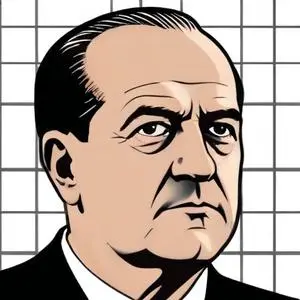
A prominent figure in Nazi Germany, serving as Minister of Armaments and War Production, known for his architectural designs and role in the war effort.
As the Minister of Armaments and War Production in Nazi Germany during World War II, Albert Speer was the mastermind behind the Third Reich's military-industrial complex, playing a crucial role in fueling the war effort with his architectural expertise and organizational skills. His remarkable ability to increase war production despite Allied bombing raids and resource shortages earned him the nickname "Miracle Man."
Albert Speer was born on March 19, 1905, in Mannheim, Germany, to a family of architects. He studied architecture at the University of Karlsruhe and later at the Technical University of Berlin, where he earned his degree in 1927. Speer joined the Nazi Party in 1931, drawn to its ideology and charismatic leader, Adolf Hitler.
In 1942, Hitler appointed Speer as Reich Minister of Armaments and War Production, responsible for overseeing the entire German war effort. Speer's innovative approaches to production and management led to a significant increase in war production, making him a valuable asset to the Nazi regime.
After the war, Speer was among the 24 major war criminals charged with crimes against humanity before the International Military Tribunal at Nuremberg. He was found guilty of war crimes and crimes against humanity, primarily for his role in exploiting slave labor, and narrowly avoided a death sentence.
Speer served his 20-year sentence at Spandau Prison, where he wrote his memoirs, which would later become the basis for his bestselling books, Inside the Third Reich and Spandau: The Secret Diaries.
Speer's post-war writings and interviews carefully constructed an image of himself as a reluctant Nazi, downplaying his role in the regime's atrocities. However, many critics argue that Speer's culpability in the Holocaust and other war crimes cannot be overstated.
Despite controversy surrounding his legacy, Speer's architectural contributions to modern urban planning and war production strategies remain significant, serving as a testament to his complex and multifaceted identity.
Speer was released from prison in 1966 and spent his remaining years writing and lecturing. He died on September 1, 1981, at the age of 76, due to complications from a stroke.
Throughout his life, Speer remained obsessed with his own legacy, striving to reconcile his architectural achievements with the moral ambiguities of his Nazi past. His story serves as a powerful reminder of the dangers of unchecked ambition and the importance of accountability in the face of historical tragedy.
In conclusion, Albert Speer's remarkable life and career embody the complexities of human nature, highlighting the tension between creative genius and moral responsibility. His story continues to captivate scholars and historians, offering a unique window into the inner workings of the Third Reich and the psyche of its leaders.
Born in 1889
The dictator of Nazi Germany, responsible for the genocide of six million Jews and millions of other people during World War II, and infamous for his extreme nationalist and anti-Semitic ideology.
Born in 1897
A mastermind of Nazi propaganda, he crafted a persuasive narrative that fueled the Third Reich's rise to power, leaving a lasting impact on the world.
Born in 1893
A high-ranking Nazi official, he was a decorated World War I fighter pilot and later became a prominent politician, serving as Minister President of Prussia. He's infamous for his role in the Nazi regime and war crimes trials.
Born in 1894
A high-ranking Nazi official who flew to Scotland on a solo mission to negotiate peace with the UK, but was instead arrested and imprisoned.
Born in 1893
A German diplomat who served as the Nazi regime's Foreign Minister, orchestrating key alliances and treaties that led to World War II. He was a close associate of Adolf Hitler and played a crucial role in shaping Nazi foreign policy.
Born in 1900
Leading the SS and Gestapo, he oversaw the Nazi regime's brutal security apparatus and implemented the "Final Solution," orchestrating the genocide of six million Jews during World War II.
Born in 1912
The longtime companion and eventually wife of the Nazi leader, known for her devotion to him and her ultimate fate of dying alongside him in the final days of World War II. She kept a private life, but her relationship with Hitler remains a subject of fascination and scrutiny.
Born in 1900
A powerful and secretive figure in the Nazi Party, known for controlling access to Hitler and overseeing the party's administrative and financial machinery. He vanished after Hitler's death, sparking decades of speculation about his fate.
