


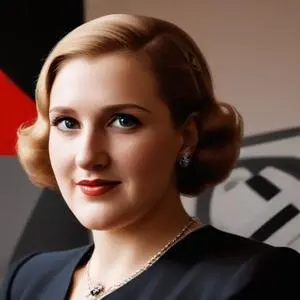
The longtime companion and eventually wife of the Nazi leader, known for her devotion to him and her ultimate fate of dying alongside him in the final days of World War II. She kept a private life, but her relationship with Hitler remains a subject of fascination and scrutiny.
Eva Braun, a German photographer and the longtime companion of Adolf Hitler, is remembered for her tumultuous relationship with the notorious dictator and her ultimate tragic fate. As Hitler's wife for a brief period, Braun's life was inextricably linked with the rise and fall of the Third Reich.
Born on February 6, 1912, in Munich, Germany, Braun was the second daughter of Friedrich Braun, a school teacher, and Franziska Kronberger, a former seamstress. Her parents' tumultuous marriage, which ended in divorce in 1921, only to be rekindled a year later, likely shaped Braun's early years.
At 17, Braun worked as an assistant and model for Heinrich Hoffmann, Hitler's personal photographer. It was during this time that she met the charismatic leader, who was 23 years her senior. Braun's initial infatuation with Hitler would eventually blossom into a complex and intense relationship.
Braun's early years with Hitler were marked by turmoil and instability. She attempted suicide twice, in 1932 and 1935, due to Hitler's aloofness and lack of commitment. Despite these setbacks, Braun remained devoted to her partner, eventually becoming an integral part of his household at the Berghof, Hitler's alpine retreat near Berchtesgaden.
As World War II raged on, Braun lived a sheltered life, rarely venturing out of the Berghof's confines. Her role was largely confined to managing Hitler's domestic life, attending to his personal needs, and capturing his public image through her photography.
By mid-1944, Braun's sister Gretl's marriage to Hermann Fegelein, the SS liaison officer on Hitler's staff, elevated Braun's status within the inner circle. She began attending public events alongside Hitler, marking a significant shift in her role from mistress to partner.
As the Allies closed in on Berlin, Braun joined Hitler in the Führerbunker, the heavily fortified underground complex beneath the Reich Chancellery garden. On April 29, 1945, Braun married Hitler in a brief civil ceremony, at which she was 33 and he was 56.
Less than 40 hours later, the couple died by suicide, Braun by biting and swallowing a cyanide capsule, and Hitler by a gunshot to the head. Their bodies were burned in the garden above, marking a tragic end to a tumultuous relationship.
Braun's life, though shrouded in controversy, offers a fascinating glimpse into the inner workings of the Third Reich. Her photography, much of which has survived to this day, provides a unique perspective on Hitler's public persona and the regime's propaganda machine.
While Braun's legacy is inextricably linked with Hitler's, her story serves as a poignant reminder of the consequences of blind devotion and the devastating impact of war on individual lives.
Through Braun's tumultuous life and tragic demise, we are reminded of the human cost of war and the devastating consequences of blind devotion.
Born in 1889
The dictator of Nazi Germany, responsible for the genocide of six million Jews and millions of other people during World War II, and infamous for his extreme nationalist and anti-Semitic ideology.
Born in 1897
A mastermind of Nazi propaganda, he crafted a persuasive narrative that fueled the Third Reich's rise to power, leaving a lasting impact on the world.
Born in 1893
A high-ranking Nazi official, he was a decorated World War I fighter pilot and later became a prominent politician, serving as Minister President of Prussia. He's infamous for his role in the Nazi regime and war crimes trials.
Born in 1900
Leading the SS and Gestapo, he oversaw the Nazi regime's brutal security apparatus and implemented the "Final Solution," orchestrating the genocide of six million Jews during World War II.
Born in 1894
A high-ranking Nazi official who flew to Scotland on a solo mission to negotiate peace with the UK, but was instead arrested and imprisoned.
Born in 1893
A German diplomat who served as the Nazi regime's Foreign Minister, orchestrating key alliances and treaties that led to World War II. He was a close associate of Adolf Hitler and played a crucial role in shaping Nazi foreign policy.
Born in 1900
A powerful and secretive figure in the Nazi Party, known for controlling access to Hitler and overseeing the party's administrative and financial machinery. He vanished after Hitler's death, sparking decades of speculation about his fate.
Born in 1905
A prominent figure in Nazi Germany, serving as Minister of Armaments and War Production, known for his architectural designs and role in the war effort.
