


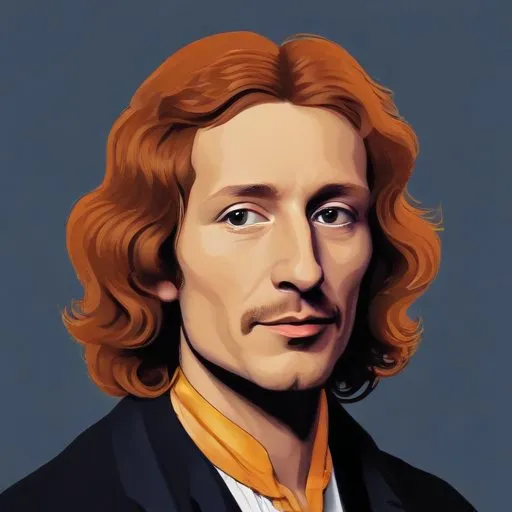
A 17th-century Dutch master of words and music, known for his lyrical poetry and innovative compositions that blended French and Italian styles. He was a true Renaissance man, excelling in multiple artistic fields.
As a luminary of the Dutch Golden Age, Constantijn Huygens left an indelible mark on the world of art, literature, music, and politics. He is renowned for being a poet, composer, and secretary to two Princes of Orange, Frederick Henry and William II, as well as the father of the prominent scientist Christiaan Huygens.
Born on September 4, 1596, in The Hague, Constantijn Huygens was the second son of Christiaan Huygens senior, secretary of the Council of State, and Susanna Hoefnagel, niece of the Antwerp painter Joris Hoefnagel. His childhood was marked by a rich cultural upbringing, with his parents providing him with a comprehensive education in music, art, and literature.
Constantijn's musical journey began at the tender age of five, when he received his first singing lessons. His brother Maurits and he were taught by their father and later by expert governors. They learned to recognize notes using gold-colored buttons on their jackets, a novel approach that set them apart from their contemporaries.
As he grew older, Constantijn's musical prowess became evident. He excelled in playing the lute, and by the age of eleven, he was already performing for ensembles. His lute playing was in high demand, earning him invitations to play at the Danish Court and for James I of England.
Huygens' artistic sensibilities were shaped by his family's impressive art collection and their connections to the esteemed art dealer Gaspar Duarte. This exposure instilled in him a deep appreciation for the arts, which would later manifest in his own creative endeavors.
Constantijn Huygens was a prolific poet, and his works showcased his mastery of languages, including French, Italian, and Latin. His poetry often explored themes of love, nature, and spirituality, demonstrating his profound understanding of the human experience.
In 1647, he published his seminal work, Pathodia sacra et profana, a collection of airs de cour, madrigals, and psalms that showcased his remarkable talent as a composer.
As a diplomat and politician, Constantijn Huygens played a crucial role in shaping the Dutch Golden Age. He served as secretary to two Princes of Orange, Frederick Henry and William II, and was instrumental in fostering cultural and political ties between the Netherlands and European nations.
One of his most significant personal milestones was the birth of his son, Christiaan Huygens, who would go on to become a renowned scientist and make groundbreaking contributions to the field of optics.
Constantijn Huygens' impact on Dutch culture and society is immeasurable. As a poet, composer, and statesman, he embodied the Renaissance ideal of a polymath. His passion for the arts, his dedication to public service, and his commitment to fostering cultural exchange have left an indelible mark on the world.
Today, Huygens is remembered as a multifaceted genius, whose contributions continue to inspire and enrich our understanding of the Dutch Golden Age.
"Music is the silent speech of the soul."
This quote, attributed to Constantijn Huygens, captures the essence of his artistic philosophy, which saw music as a powerful medium for expressing the deepest human emotions.
Born in 1587
A 17th-century master of Dutch literature, penning influential plays and poems that shaped the country's cultural identity. His works remain a testament to his innovative storytelling and poetic flair.
Born in 1610
A 17th-century master of peasant scenes, capturing rustic life with humor and empathy. His genre paintings offer a glimpse into the daily lives of ordinary people.
Born in 1622
A Dutch master of light and shadow, known for his innovative use of chiaroscuro and his captivating, intimate portraits.
