


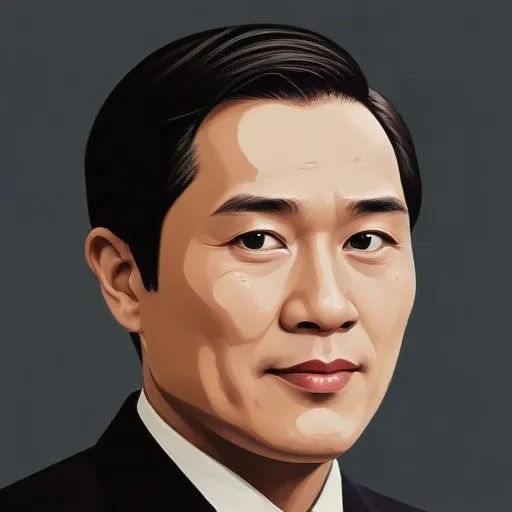
A former Chinese news anchor who exposed corruption and sparked a national debate on media censorship, becoming a symbol of press freedom.
Cui Yongyuan is a household name in China, known for his fearless whistleblowing in the entertainment industry, particularly for exposing the notorious "yin-yang contracts" that led to the downfall of actress Fan Bingbing's career.
With his affable and natural sense of humor, Cui has pioneered a brand of relaxed and unscripted presentation style that has captivated audiences and inspired a new generation of TV hosts.
Cui was born on February 20, 1963, in the Beichen District of Tianjin, China. His father was in the military, and the family moved to Beijing when Cui was just three years old.
Cui attended primary and high school in Beijing and later graduated from the Communication University of China in 1985. He began working for China Central Television (CCTV) as a reporter shortly after graduation.
Cui's breakthrough came in 1996 when he started hosting the popular talk show "Tell It Like It Is" on CCTV. The show was conceptualized as a Sunday supplement to the "Oriental Horizon" program and was an instant hit, thanks to Cui's infectious personality and humor.
The show's success led to Cui becoming a national celebrity, and he was invited to host the 2000 edition of the CCTV New Year's Gala. He went on to host several other popular shows, including "Talk with Xiaocui" and "Thank the Heavens and the Earth that you are here."
Cui has been vocal about the need for authenticity and transparency in the entertainment industry. His whistleblowing efforts have led to greater accountability and reform in the industry.
Through his work, Cui has inspired a new generation of TV hosts to adopt a more natural and spontaneous presentation style, moving away from the traditional scripted formats.
Cui has been open about his struggles with depression, and has used his platform to raise awareness about mental health issues.
He has also been vocal about his personal growth and self-improvement, inspiring his fans to prioritize their own well-being and happiness.
Cui's impact on Chinese popular culture cannot be overstated. He has inspired a new generation of TV hosts, and his fearless whistleblowing has led to greater accountability in the entertainment industry.
Through his work, Cui has promoted values such as authenticity, transparency, and self-improvement, inspiring millions of fans across China.
Cui Yongyuan's legacy extends far beyond his impressive list of accomplishments. He has left an indelible mark on Chinese television, inspiring a new era of relaxed and unscripted presentation styles.
As a trailblazer in the entertainment industry, Cui's fearless spirit and commitment to authenticity have inspired a new generation of TV hosts and celebrities.
In conclusion, Cui Yongyuan is a true icon in Chinese entertainment, known for his fearless whistleblowing, infectious personality, and commitment to authenticity. His legacy will continue to inspire and influence generations to come.
Born in 1926
Former Chinese leader who ruled the country from 1989 to 2004, known for his economic reforms and authoritarian grip on power. He's also famous for his "Three Represents" theory, which aimed to broaden the Communist Party's appeal.
83 Years Old
The 5th Paramount leader of China, who served from 2002 to 2012, is known for his role in China's rapid economic growth and his "Scientific Development Concept" policy. He also increased China's global influence through strategic diplomacy.
73 Years Old
The supreme leader of China, overseeing the country's rapid economic growth and asserting its global influence, while consolidating power and cracking down on dissent.
98 Years Old
A Chinese engineer-turned-politician who served as the 5th Premier of the People's Republic of China, known for his economic reforms and role in China's rapid growth. He's credited with transforming China into the world's second-largest economy.
71 Years Old
The 7th Premier of the People's Republic of China, serving from 2013 to 2023, oversaw China's economic reforms and played a key role in shaping the country's global influence. He implemented policies to boost domestic consumption and reduce reliance on exports.
