


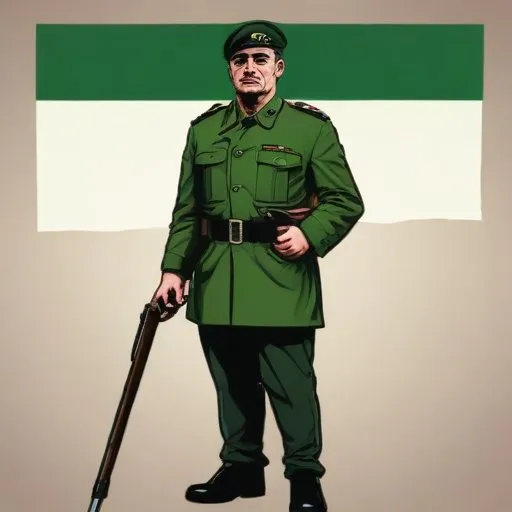
Irish revolutionary and guerrilla fighter who played a key role in the Irish War of Independence and later became a prominent figure in the anti-Treaty Irish Republican Army. He is known for his bravery and unwavering commitment to the Irish republican cause.
Dan Keating was a lifelong Irish republican and former president of the Republican Sinn Féin, known for his unwavering dedication to the cause of Irish independence and his unrelenting opposition to British rule. At the time of his death in 2007, he was Ireland's oldest man and the last surviving veteran of the Irish War of Independence.
Born on January 2, 1902, Keating joined Fianna Éireann in 1918, a year that marked the beginning of his lifelong commitment to the Irish republican movement. In 1920, during the Irish War of Independence, he joined the Boherbee B Company, 3rd Battalion, 1st Kerry Brigade, Irish Republican Army (IRA).
Keating's involvement in the war saw him participate in several notable events, including the shooting of Royal Irish Constabulary (RIC) Constable Denis O'Loughlin in 1921, and an ambush between Castlemaine and Milltown that claimed the lives of five RIC men. He also fought in a gun battle with the British Army near Castleisland, which resulted in the deaths of four British soldiers and five IRA volunteers.
Keating opposed the 1921 Anglo-Irish Treaty, which established the Irish Free State, and fought on the anti-treaty side in the Irish Civil War. He was involved in operations in Listowel, Kerry, Limerick, and Tipperary before his column was arrested by Free State Forces.
Keating was interned by the Irish Free State government and spent seven months in Maryborough Gaol (now known as Portlaoise Prison) and the Curragh Camp before being released in March 1924. In 1933, he was involved in an attempt to assassinate Eoin O'Duffy, the leader of the Irish Blueshirts, during a visit to County Kerry.
In his later life, Keating continued to be involved in republican activity, serving as president of the Republican Sinn Féin from 1996 to 2003. He passed away on October 2, 2007, at the age of 105, leaving behind a legacy as one of the last remaining links to Ireland's struggle for independence.
Dan Keating's life was a testament to his unwavering commitment to the cause of Irish independence and his unrelenting opposition to British rule. His bravery and sacrifice during the Irish War of Independence and the Irish Civil War paved the way for Ireland's independence and earned him a place in the annals of Irish history.
Through his involvement in various republican organizations, Keating played a significant role in shaping Ireland's political landscape, inspiring generations of Irish republicans to continue the fight for independence and self-determination.
Keating's legacy serves as a reminder of the sacrifices made by those who fought for Ireland's freedom and the importance of preserving their stories for future generations.
Born in 1890
Leader of the Irish independence movement, instrumental in negotiating the Anglo-Irish Treaty, and a key figure in the Irish War of Independence.
Born in 1882
Leader of Ireland's struggle for independence from Britain, serving as both Prime Minister and President, and key figure in shaping the country's modern identity.
Born in 1904
Irish lawyer and politician who served as Minister for External Affairs and was awarded the Nobel Peace Prize for his humanitarian work, particularly in the area of human rights. He was a key figure in the formation of Amnesty International.
