


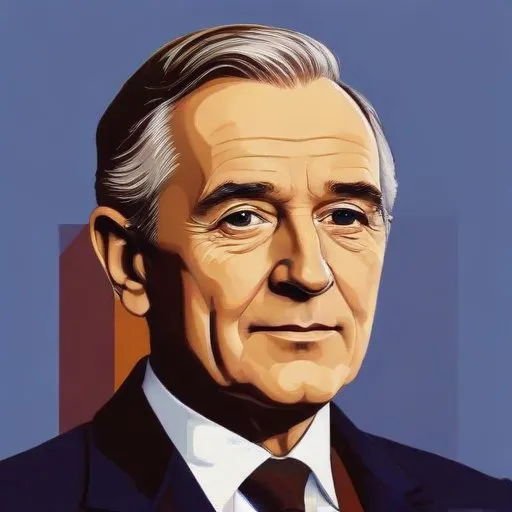
Irish lawyer and politician who served as Minister for External Affairs and was awarded the Nobel Peace Prize for his humanitarian work, particularly in the area of human rights. He was a key figure in the formation of Amnesty International.
Sen MacBride is best known for his tireless efforts to promote human rights and international cooperation, earning him the Nobel Peace Prize in 1974. As a politician, lawyer, and statesman, MacBride made significant contributions to Irish and global politics, leaving an indelible mark on the world.
Born on January 26, 1904, in Paris, France, MacBride was the son of Maud Gonne, a prominent Irish nationalist, and Major John MacBride, who was executed by the British for his involvement in the Easter Rising. MacBride's early life was marked by his mother's activism and his father's sacrifice, which instilled in him a strong sense of justice and conviction.
MacBride's educational background was shaped by his time at the Jesuit Lyce Saint-Louis-de-Gonzague in Paris and later at Mount St Benedicts in Gorey, County Wexford, Ireland. He also briefly attended the Downside School.
MacBride's entry into politics began during the 1918 Irish general election, where he actively campaigned for Sinn Féin. At just 15 years old, he joined the Irish Volunteers, which fought for Irish independence.
In the 1930s, MacBride became the Chief of Staff of the Irish Republican Army (IRA) and later founded the political party Clann na Poblachta. He served as Minister for External Affairs from 1948 to 1951 and led his party from 1946 to 1965.
MacBride's influence extended far beyond Ireland's borders. He was a key figure in the establishment of the United Nations, the Council of Europe, and Amnesty International. His dedication to human rights and international cooperation earned him numerous accolades, including the Lenin Peace Prize in 1975-1976 and the UNESCO Silver Medal for Service in 1980.
MacBride's philosophical outlook was shaped by his commitment to pacifism, human rights, and social justice. He believed in the power of international cooperation and diplomacy to resolve conflicts and promote peace.
Throughout his life, MacBride remained steadfast in his convictions, even in the face of adversity. His unwavering dedication to his principles earned him respect and admiration from around the world.
Sen MacBride's legacy continues to inspire generations of human rights activists, politicians, and individuals committed to creating a more just and peaceful world. His tireless efforts to promote international cooperation, human rights, and social justice have left an indelible mark on global politics.
Today, MacBride's name is synonymous with courage, conviction, and dedication to the causes he championed. His life's work serves as a powerful reminder of the importance of standing up for what is right, even in the face of adversity.
Born in 1882
Leader of Ireland's struggle for independence from Britain, serving as both Prime Minister and President, and key figure in shaping the country's modern identity.
Born in 1899
A key figure in Ireland's struggle for independence and economic development, he played a crucial role in shaping the country's modern identity and economy. He's most known for his efforts to modernize Ireland and move it away from its agricultural past.
Born in 1917
A former footballer who became the 5th Taoiseach of Ireland, leading the country through a tumultuous period in the late 1960s and early 1970s. He's known for his role in shaping Ireland's modern identity.
Born in 1920
The 6th Taoiseach of Ireland, a lawyer-turned-politician who led the country from 1973 to 1977, known for his strong stance against the IRA and his role in shaping Ireland's economy.
Born in 1926
The 7th Taoiseach of Ireland, a lawyer-turned-politician, led the country through significant economic and social reforms, earning him a reputation as a champion of liberalization and modernization.
Born in 1925
A charismatic and controversial leader who served as Ireland's prime minister, known for his role in shaping the country's economy and politics during the 1980s.
93 Years Old
The 9th Taoiseach of Ireland, a key figure in the Northern Ireland peace process, known for his role in negotiating the 1993 Downing Street Declaration. He was a prominent businessman and politician who played a crucial role in shaping Ireland's modern history.
75 Years Old
The 11th Taoiseach of Ireland, a skilled politician who played a crucial role in the Northern Ireland peace process, and oversaw a period of rapid economic growth in Ireland.
