


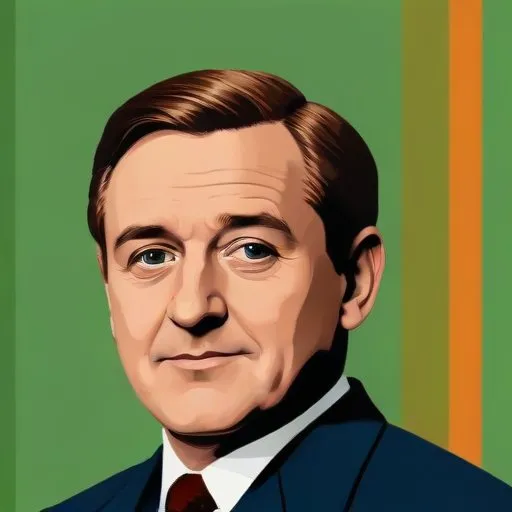
The 7th Taoiseach of Ireland, a lawyer-turned-politician, led the country through significant economic and social reforms, earning him a reputation as a champion of liberalization and modernization.
As the seventh Taoiseach of Ireland, Garret FitzGerald left an indelible mark on the country's political landscape, serving two terms from 1981 to 1982 and 1982 to 1987. He was a powerhouse of intellectual and economic reform, charting a course for Ireland's integration into the European Community and cementing his legacy as a champion of social and economic progress.
Born in Ballsbridge, Dublin, on February 9, 1926, FitzGerald was destined for greatness. His father, Desmond FitzGerald, was a pioneering figure in Irish politics, serving as the country's first Minister for External Affairs. This illustrious family background instilled in Garret a sense of duty and responsibility, which he would go on to fulfill in his own remarkable career.
FitzGerald's entry into politics was marked by his election to the Seanad Éireann, the Irish Senate, in 1965. He soon won a seat in the Dáil Éireann, the lower house of the Oireachtas, in 1969. His leadership qualities and mastery of economic policy soon propelled him to the forefront of Fine Gael, Ireland's center-right party. In 1977, he became the party's leader, a position he held until 1987.
FitzGerald's tenure as Taoiseach was marked by a slew of landmark reforms, including:
Garret FitzGerald was an accomplished economist, barrister, and writer. He penned numerous articles and books on economics, politics, and history, cementing his reputation as a public intellectual of rare distinction. His writings continue to inspire and inform Irish policymakers to this day.
FitzGerald's impact on modern Ireland is profound and lasting. He envisioned a country that was economically robust, socially progressive, and fully integrated into the European community. Through his tireless efforts, he helped bring Ireland closer to realizing this vision. Even in retirement, he remained an active and engaged citizen, continuing to contribute to public discourse until his passing on May 19, 2011.
In conclusion, Garret FitzGerald's life and legacy serve as a testament to the power of visionary leadership, intellectual curiosity, and a deep commitment to public service. He will be remembered as one of Ireland's greatest statesmen, a champion of progress, and an inspiration to generations to come.
Born in 1925
A charismatic and controversial leader who served as Ireland's prime minister, known for his role in shaping the country's economy and politics during the 1980s.
Born in 1917
A former footballer who became the 5th Taoiseach of Ireland, leading the country through a tumultuous period in the late 1960s and early 1970s. He's known for his role in shaping Ireland's modern identity.
Born in 1920
The 6th Taoiseach of Ireland, a lawyer-turned-politician who led the country from 1973 to 1977, known for his strong stance against the IRA and his role in shaping Ireland's economy.
Born in 1899
A key figure in Ireland's struggle for independence and economic development, he played a crucial role in shaping the country's modern identity and economy. He's most known for his efforts to modernize Ireland and move it away from its agricultural past.
Born in 1882
Leader of Ireland's struggle for independence from Britain, serving as both Prime Minister and President, and key figure in shaping the country's modern identity.
75 Years Old
The 11th Taoiseach of Ireland, a skilled politician who played a crucial role in the Northern Ireland peace process, and oversaw a period of rapid economic growth in Ireland.
77 Years Old
Acclaimed author of concise, witty, and poignant short stories and novels that explore the complexities of human relationships and the American experience.
89 Years Old
A Northern Irish educator and politician who played a key role in the Northern Ireland peace process, earning him the Nobel Peace Prize in 1998. He is known for his tireless efforts to bring about reconciliation and peace in his homeland.
