


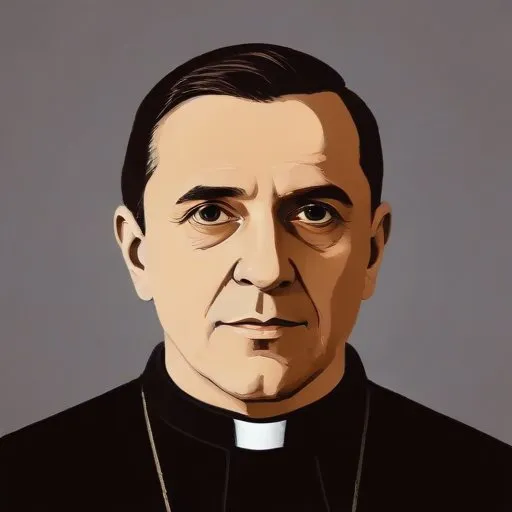
A 17th-century Italian Jesuit priest who wrote influential biographies of Jesuit saints and was a prominent historian of the Jesuit order, known for his detailed and engaging writings.
Daniello Bartoli, a renowned Italian Jesuit writer and historiographer, is celebrated for his remarkable contributions to literature and science. Born in Ferrara on February 12, 1608, Bartoli's works earned him the esteemed title of "the Dante of Italian prose" by poet Giacomo Leopardi.
Bartoli's fascination with literature and science began at a young age. As the youngest of three sons, he was barely fifteen when he embarked on a vocation to the Society of Jesus in 1623. After a two-year novitiate in Novellara, Bartoli resumed his studies in Piacenza in 1625, where he excelled in science and letters.
Under the guidance of Jesuit scientists Giovanni Battista Riccioli and Niccolo Zucchi, Bartoli, along with his contemporary Francesco Maria Grimaldi, was involved in groundbreaking experiments and discoveries in the planetary heavens. On May 17, 1630, Bartoli and Zucchi became one of the first to observe the equatorial belts on the planet Jupiter, a remarkable achievement that underscored Bartoli's curiosity and passion for scientific inquiry.
Bartoli's literary talents flourished, and he went on to write several notable works, including Il torto ed il diritto del Non si pu (1655), where he used the pseudonym Ferrante Longobardi to assert his independence from the linguistic dominance of Florence. His historiographical works earned him recognition as a master of Italian prose, and his contributions to the literary world were unparalleled.
From 1629 to 1634, Bartoli taught grammar and rhetoric to the boys of the Jesuit collegio in Parma, instilling in them a love for learning and literature. In 1634, he was ordained a priest, further solidifying his commitment to the Society of Jesus.
Daniello Bartoli's remarkable life and works have left an indelible mark on Italian literature and science. His dedication to the pursuit of knowledge and his passion for exploring the wonders of the natural world have inspired generations of scholars and writers. Today, he is remembered as a true Renaissance figure, whose contributions continue to enrich our understanding of the world around us.
Through his extraordinary accomplishments, Daniello Bartoli has secured his place in the annals of Italian history, leaving behind a legacy that continues to inspire and captivate scholars and enthusiasts alike.
Born in 1491
Founded the Jesuit Order, a Catholic religious organization known for its missionary and educational work, and developed the Spiritual Exercises, a guide for spiritual growth and discernment.
Born in 1506
Co-founder of the Society of Jesus, a Catholic religious order, known for his missionary work in Asia, especially in India and Japan, and for his role in the Counter-Reformation. He's revered for his tireless efforts to spread Christianity and his compassion for the poor and marginalized.
Born in 1521
A 16th-century Jesuit priest and doctor of the church, he played a crucial role in counter-reformation efforts, and his writings helped shape Catholic theology.
Born in 1542
A 16th-century theologian and doctor of the Church, known for his writings on spirituality and his role in shaping Catholic doctrine. He was a key figure in the Counter-Reformation, defending Catholicism against Protestantism.
Born in 1568
This 16th-century Jesuit saint is revered for his selfless devotion to caring for plague victims, ultimately sacrificing his life to save others. He's a powerful symbol of compassion and charity.
Born in 1599
A 17th-century Belgian Jesuit scholastic and saint, known for his piety, kindness, and devotion to his studies, becoming a model for young Jesuits. He's revered for his heroic virtues and miracles attributed to his intercession.
Born in 1550
A 16th-century Jesuit novice who died at 18, known for his strong devotion and miraculous healings, becoming a patron saint of youth and Poland.
Born in 1538
A 16th-century Italian reformer who played a key role in the Counter-Reformation, implementing significant reforms within the Catholic Church, and was known for his piety and charitable works.
