


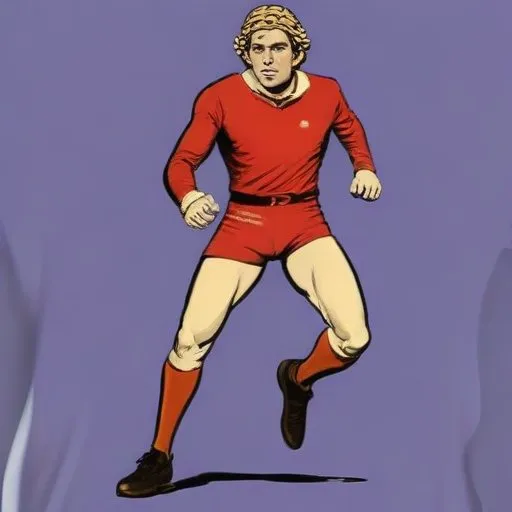
A British athlete and politician who won Olympic gold in the 400m hurdles in 1928 and later served in the House of Lords
David Cecil, 6th Marquess of Exeter, also known as David Burghley, was a multifaceted individual renowned for his exceptional athletic prowess, particularly in the 400 meters hurdles event, which earned him a gold medal at the 1928 Summer Olympics. Additionally, he was a distinguished politician, serving as a Member of Parliament and a Conservative Party stalwart, as well as an esteemed sports official and scholar.
Born on February 9, 1905, near Stamford, Lincolnshire, Lord Burghley was the heir to the 5th Marquess of Exeter. He received his education at Institut Le Rosey in Switzerland, Ludgrove School, Eton College, and Magdalene College, Cambridge. During his time at Cambridge, he served as the president of the Cambridge University Athletics Club and was a member of the Pitt Club.
Burghley's athletic career was marked by numerous accolades and records. He won the British AAA championships in the 120 yards hurdles from 1929 to 1931 and the 440 yards hurdles from 1926 to 1928, as well as in 1930 and 1932. His Olympic debut came in 1924 in Paris, where he was eliminated in the first round of the 110 meters hurdles event. However, he redeemed himself at the 1928 Summer Olympics, winning the gold medal in the 400 meters hurdles event with a narrow margin of 0.2 seconds over the American athletes Frank Cuhel and Morgan Taylor.
In 1930, Burghley participated in the first Commonwealth Games, where he clinched victories in both hurdling events and contributed to the gold medal-winning British 4 × 440 yards relay team. During this period, he set several British records, including a remarkable 24.7 seconds in the 220 yards hurdles, which stood unbroken until 1950.
In 1931, Burghley was elected as the Member of Parliament for Peterborough, a position he held until 1943. His athletic career continued to flourish, and he was granted a leave of absence to compete in the 1932 Summer Olympics, where he secured a silver medal as a member of the British 4 × 400 meters relay team, setting a new European record in the process.
In 1933, Burghley became a member of the International Olympic Committee (IOC), a testament to his dedication to the world of sports. Throughout his life, he remained committed to promoting athletics and was instrumental in shaping the sport's governing bodies. His legacy extends beyond his athletic prowess, as he contributed significantly to the development of sports administration and inspired future generations of athletes.
Burghley succeeded to the Marquessate of Exeter in 1956. He passed away on October 21, 1981, leaving behind a rich legacy in the realms of sports, politics, and academia.
David Cecil, 6th Marquess of Exeter, was an extraordinary individual whose accomplishments in athletics, politics, and sports administration have left an indelible mark on history. His remarkable career serves as a testament to his dedication, perseverance, and commitment to excellence.
Born in 1871
Prolific writer of historical novels and adventure stories, also a talented landscape painter.
Born in 1897
A British politician who served as Prime Minister from 1955 to 1957, known for his role in the Suez Crisis and his diplomatic efforts during the Cold War.
Born in 1894
A British politician who served as Prime Minister from 1957 to 1963, known for leading the country through a period of economic prosperity and decolonization.
Born in 1903
A British aristocrat who served as Prime Minister from 1963 to 1964, known for his brief tenure and aristocratic background.
