


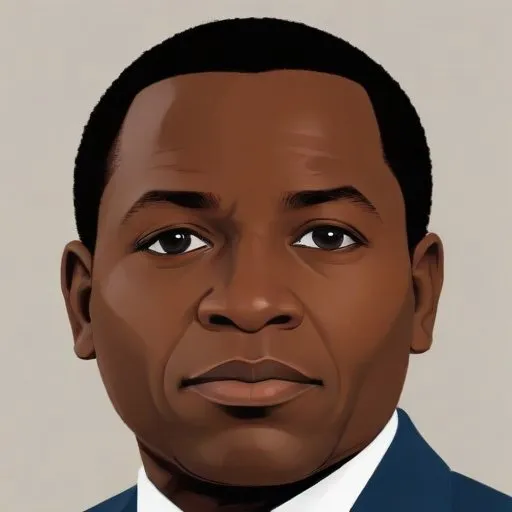
First President of the Central African Republic, serving from 1960 to 1966 and again from 1979 to 1981, known for his role in the country's transition to independence and his later overthrow.
David Dacko, a name synonymous with the tumultuous history of the Central African Republic, served as the country's first president not once, but twice. His remarkable yet tumultuous journey spanned over five decades, marked by power struggles, coups, and a relentless pursuit of democratic ideals.
Born on March 24, 1930, in the village of Bouchia, Dacko's early life was shaped by his family's modest means and the French colonial administration's presence in the region. His father, Joseph Iniabod, converted to Catholicism in 1937, which led to a significant change in the family's dynamics. Dacko's education, however, remained a top priority. He attended primary school in Mbaiki and later continued his studies at the Ecole normale of Mouyoundzi in Moyen Congo, where he trained to become a teacher.
Dacko's career as a schoolmaster and educationist laid the foundation for his entry into politics. He became a vocal supporter of independence leader Barthlmy Boganda, who shared his vision for a free and unified Central African Republic. As the country inched closer to independence, Dacko's popularity grew, and he was appointed Prime Minister in 1959, a position he held until 1960, when he assumed the presidency.
Dacko's first presidential term was marked by instability and power struggles. He faced opposition from rival factions, including his distant cousin, Jean-Bdel Bokassa, who would later overthrow him in 1966. Despite these challenges, Dacko implemented several reforms, including the creation of a national army and the establishment of a unicameral legislature.
Following his ousting, Dacko went into exile, where he continued to advocate for democratic reforms and human rights. He remained a vocal critic of the Bokassa regime, which was marked by human rights abuses and corruption.
In 1979, Dacko returned to power, this time as a result of a popular uprising against the Bokassa regime. His second tenure was short-lived, however, as he was again ousted in a coup led by General Andr Kolingba in 1981.
Despite his removal from power, Dacko remained an active opposition figure, participating in several presidential elections and continuing to advocate for democratic reforms. He passed away on November 20, 2003, leaving behind a legacy of perseverance and dedication to his country.
Dacko's legacy is complex and multifaceted. While his presidencies were marked by instability and power struggles, he remained a vocal advocate for democratic ideals and human rights throughout his life. His influence on the Central African Republic's political landscape is undeniable, and his story serves as a testament to the country's tumultuous history.
Dacko's story is a testament to the complexities of African politics and the importance of perseverance in the face of adversity. His legacy continues to inspire and shape the Central African Republic's ongoing struggle for democracy and stability.
Born in 1921
A notorious dictator who ruled the Central African Republic with an iron fist, known for his lavish spending and brutal human rights abuses.
Born in 1918
First President of Chad, leading the country to independence from France in 1960 and serving until his assassination in 1975. He's known for his efforts to modernize and unify the newly independent nation.
89 Years Old
The first engineer to become President of the Central African Republic, serving from 1993 to 2003 and known for his efforts to reform the country's economy and infrastructure. He was ousted in a coup after allegations of corruption and nepotism.
80 Years Old
A former general who seized power in a coup, ruling the Central African Republic with an iron fist, marked by human rights abuses and corruption. He was ousted in 2013 after a decade in power.
70 Years Old
Interim leader who restored stability to the Central African Republic during a period of civil war, becoming the first female head of state in the country's history. She worked to reconcile warring factions and pave the way for democratic elections.
