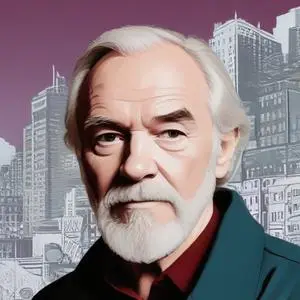
David Harvey: A Pioneering Geographer and Marxist Scholar
A Proponent of the Right to the City
David Harvey, a British-American academic, is renowned for his groundbreaking Marxist analyses that delve into the realms of urban geography, economy, and social justice. As a distinguished professor of anthropology and geography at the City University of New York (CUNY), Harvey has authored numerous influential books and essays that have significantly contributed to the development of modern geography as a discipline.
Early Life and Education
Born on October 31, 1935, in Gillingham, Kent, Harvey attended Gillingham Grammar School for Boys and later pursued his undergraduate and postgraduate studies at St John's College, Cambridge. His early work, including his PhD on hops production in 19th-century Kent, was deeply rooted in historical inquiry, a tradition that would continue to influence his later research endeavors.
Career Highlights and Major Works
Harvey's academic trajectory has been marked by significant milestones, including the publication of his landmark text,
Explanation in Geography (1969), which applied principles drawn from the philosophy of science to the field of geographical knowledge. This work solidified his position as a leading figure in the methodology and philosophy of geography. However, Harvey's intellectual curiosity soon led him to explore issues of social injustice and the nature of the capitalist system, as evident in his subsequent works.
- The Limits to Capital (1982): A seminal work that critiqued the capitalist system and its inherent contradictions.
- The Condition of Postmodernity (1990): A comprehensive analysis of postmodernism and its implications on urban geography and culture.
- Spaces of Capital: Towards a Critical Geography (2001): A collection of essays that examines the relationships between capitalism, urbanization, and spatiality.
Influence on Modern Society
Harvey's scholarly contributions have had a profound impact on modern society, inspiring a new generation of scholars, activists, and policymakers to rethink the relationships between urbanization, economy, and social justice. His concept of the "right to the city" has been particularly influential, as it emphasizes the need for collective control over urban spaces and resources.
Philosophical Contributions and Beliefs
As a Marxist scholar, Harvey's work is characterized by a deep commitment to social justice and a critique of capitalist ideologies. He has long argued that the capitalist system is inherently contradictory and that true social change can only be achieved through a fundamental transformation of the existing power structures.
Personal Life and Relationships
Harvey currently resides in New York and has a daughter, Delfina, born in January 1990. His personal life has been marked by a strong commitment to social justice and activism, reflecting his philosophical beliefs and scholarly pursuits.
Awards and Honors
Harvey's contributions to the field of geography have been recognized with numerous awards and honors, including the Anders Retzius Gold Medal (1989) and the Vautrin Lud Prize (1995).
Legacy and Comparative Analysis
As one of the most cited authors in the humanities and social sciences, Harvey's influence extends beyond the field of geography to encompass a broader range of disciplines, including sociology, economics, and philosophy. His work has been compared to that of other prominent scholars, such as Henri Lefebvre and Neil Smith, who have also explored the intersections between urbanization, economy, and social justice.
Impact on Pop Culture
Harvey's ideas have permeated popular culture, influencing urban planners, architects, and activists worldwide. His concept of the "right to the city" has inspired a range of creative projects, from documentary films to urban art installations.
Predictions and Speculations
As the world grapples with the challenges of urbanization, climate change, and economic inequality, Harvey's work offers a timely and critical perspective on the need for fundamental social and economic transformation. His ideas on the "right to the city" and the imperative for collective control over urban spaces will likely continue to shape urban planning and policy discourse in the years to come.
Final Reflections
David Harvey's remarkable career is a testament to the power of critical scholarship and its ability to inspire meaningful social change. As a pioneering geographer and Marxist scholar, Harvey has left an indelible mark on the field of geography and beyond, ensuring that his ideas will continue to resonate with scholars, activists, and policymakers for generations to come.