


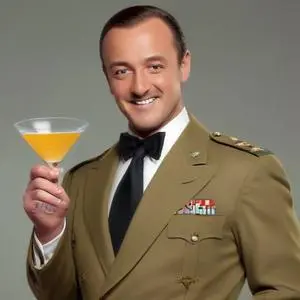
A dashing British actor and war hero, starring in iconic films like "Around the World in 80 Days" and "Separate Tables", earning him an Academy Award.
David Niven was the epitome of debonair, a handsome and charming leading man who graced the screens of Classic Hollywood with his suave presence. With an Academy Award and a Golden Globe Award to his name, Niven left an indelible mark on the film industry, captivating audiences with his versatility and range.
Born on March 1, 1910, in central London, Niven hailed from an upper-middle-class family. He attended Heatherdown Preparatory School and Stowe School before enrolling in the Royal Military College, Sandhurst. After completing his education, he was commissioned as a second lieutenant in the Highland Light Infantry.
Niven's interest in acting sparked while he was serving in the army. He began by taking small roles in films, including a nonspeaking part in Metro-Goldwyn-Mayer's Mutiny on the Bounty (1935). This early start eventually led to a contract with Samuel Goldwyn, paving the way for his rise to stardom.
Throughout the 1930s and 1940s, Niven gradually built his reputation as a leading man, starring in films like Dodsworth (1936), The Charge of the Light Brigade (1936), and The Prisoner of Zenda (1937). His breakthrough role came in 1939 with the film adaptation of Emily Brontë's classic novel, Wuthering Heights.
Niven's crowning glory came in 1958 when he won the Academy Award for Best Actor for his poignant performance in Separate Tables. He also received a Golden Globe Award for the same role, solidifying his position as a respected actor of his time.
Niven's filmography boasts an impressive list of classics, including:
One of his most iconic roles was that of Sir Charles Lytton in the 1959 film The Pink Panther, which showcased his flair for comedy and wit.
When World War II broke out, Niven returned to Britain and rejoined the army, serving as a lieutenant in the Commandos. He was involved in the production of the morale-boosting film The First of the Few (1942), which chronicled the development of the Supermarine Spitfire fighter plane.
David Niven's enduring legacy lies in his ability to captivate audiences with his effortless charm and versatility. He remains an iconic figure in the world of Classic Hollywood, inspiring generations of actors and filmmakers. His contributions to the film industry continue to be celebrated, and his charming on-screen presence remains timeless.
Born in 1921
A renowned actor, director, and writer who brought wit and charm to numerous film and stage productions, earning him multiple Academy Awards and a knighthood. He's particularly famous for his iconic roles in movies like "Spartacus" and "Death on the Nile".
Born in 1914
A renowned actor who brought iconic characters to life on screen, including Obi-Wan Kenobi in the Star Wars franchise.
Born in 1904
A renowned thespian, celebrated for his commanding stage presence and iconic performances in Shakespearean plays and films, earning him a knighthood.
Born in 1902
A renowned stage and screen actor, celebrated for his distinctive voice and authoritative presence, starring in iconic films like "David Copperfield" and "Doctor Zhivago".
Born in 1907
A renowned thespian who dominated the British stage and screen, bringing Shakespearean characters to life with his commanding presence and rich voice.
Born in 1913
A talented actress who won two Academy Awards for her iconic portrayals of Southern belles in "Gone with the Wind" and "A Streetcar Named Desire".
Born in 1921
A renowned actress of Hollywood's Golden Age, starring in iconic films like "From Here to Eternity" and "The King and I", earning six Academy Award nominations.
Born in 1909
A renowned actor, producer, and screenwriter, he brought iconic characters to life in films like "North by Northwest" and "20,000 Leagues Under the Sea".
