


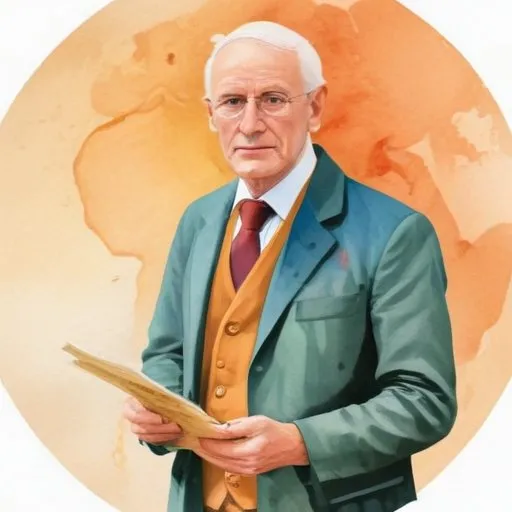
A renowned expert in human origins, environmental adaptation, and cultural evolution, known for groundbreaking research on early human migrations and the development of agriculture.
David R. Harris, a celebrated British geographer, anthropologist, and archaeologist, is renowned for his groundbreaking work on the origins of agriculture and the domestication of plants and animals. His exhaustive research has significantly contributed to our understanding of human-environment interactions, making him a stalwart in the academic community.
Harris was born on December 14, 1930, in London, England. He pursued his undergraduate studies at University College, Oxford, where he earned a BA in Geography. He furthered his education at Oxford, earning an M.Litt. in Geography in 1955 with a thesis on water resources and land use in Tunisia. In 1963, he received a PhD from the University of California, Berkeley, with a dissertation on the ecological study of Antigua, Barbuda, and Anguilla.
Harris served in the Royal Air Force from 1949 to 1950 as part of National Service. He began his academic career by lecturing in geography at Queen Mary College, University of London, from 1958 to 1964. During the 1962-1963 academic year, he was a visiting lecturer at the University of New Mexico in Albuquerque, where he continued his doctoral studies at the University of California, Berkeley.
In 1964, Harris joined University College London (UCL) as a Reader in Geography, later becoming a professor at the Institute of Archaeology in 1980. He succeeded John Davies Evans as the Director of the Institute in 1989 and held the position until his retirement. During his tenure, he launched the postgraduate academic research journal Papers from the Institute of Archaeology.
Harris's work has had a profound impact on our understanding of human-environment interactions, particularly in the context of agriculture and domestication. His research has spanned multiple disciplines, including geography, anthropology, and archaeology. He has made significant contributions to the field of archaeology, particularly in the areas of ecological and environmental archaeology.
Harris's legacy extends beyond his academic contributions. He has inspired generations of scholars and researchers, shaping the course of their work and encouraging them to explore new areas of inquiry.
Harris's contributions to the field of archaeology and anthropology have been recognized with numerous awards and honors. He has been elected as a Fellow of the Society of Antiquaries and a Fellow of the British Academy, among other prestigious accolades.
Harris passed away on December 25, 2013, leaving behind a legacy of groundbreaking research and a community of scholars inspired by his work.
90 Years Old
A renowned geographer and academic who has made significant contributions to the field of Marxist geography, critically analyzing the effects of capitalism on urban spaces and social inequality.
82 Years Old
A pioneering geographer who challenged traditional notions of space and place, and a vocal advocate for social justice and equality.
Born in 1924
A pioneering social historian and activist who reshaped the field of history with his groundbreaking works on the British working class, particularly "The Making of the English Working Class".
Born in 1921
A cultural critic and Marxist theorist who explored the relationships between literature, culture, and society, shaping the field of cultural studies.
Born in 1917
A renowned historian and author who wrote extensively on the rise of industrial capitalism and the development of socialist and communist movements in the 19th and 20th centuries. His works provide insightful perspectives on modern history and its complexities.
