


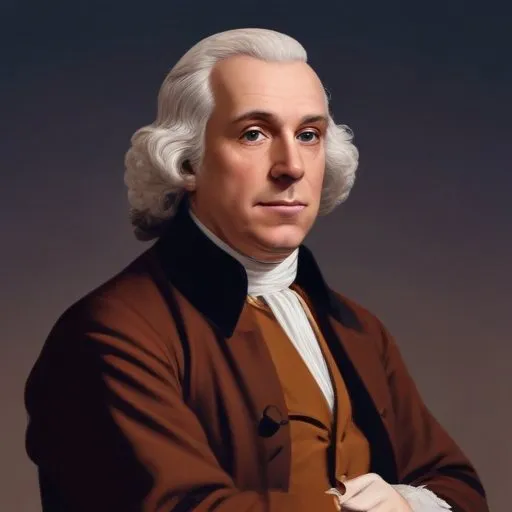
An American polymath who made significant contributions to astronomy, mathematics, and physics, and is credited with being the first to observe and record a transit of Venus in 1769.
David Rittenhouse, a towering figure in American scientific and cultural history, is celebrated for his groundbreaking contributions to astronomy, mathematics, and scientific instrumentation. As the first director of the United States Mint, he played a pivotal role in shaping the country's financial landscape.
Rittenhouse was born on April 8, 1732, in Rittenhousetown, Pennsylvania, to a family of humble means. Despite his lack of formal education, he demonstrated a prodigious talent for mathematics and science from an early age. Self-taught and driven by curiosity, Rittenhouse's intellectual hunger led him to master Isaac Newton's laws of motion and gravity by the age of 13.
At 17, he constructed a clock with wooden gears, showcasing his exceptional craftsmanship and ingenuity. This early feat marked the beginning of a lifelong passion for scientific instrumentation and innovation.
Rittenhouse's most notable achievements lie in his work on orreries, intricate scale models of the solar system. He built two such orreries, one for Princeton University and another for the University of Pennsylvania, which showcased his exceptional skill as a scientific instrument craftsman.
His dedication to astronomy and scientific inquiry led him to become a respected member of the American Philosophical Society, where he rubbed shoulders with the likes of Benjamin Franklin and Thomas Jefferson.
Rittenhouse's leadership and expertise extended beyond the realm of science to public service. In 1792, he was appointed the first director of the United States Mint, overseeing the minting of coins and playing a crucial role in shaping the country's financial infrastructure.
Throughout his life, Rittenhouse embodied the spirit of American ingenuity and innovation. His legacy continues to inspire generations of scientists, inventors, and thinkers, solidifying his place as one of the most influential figures in American history.
Rittenhouse's contributions to science, mathematics, and public service have left an indelible mark on American society. His work on orreries and scientific instrumentation has inspired generations of scientists and inventors, pushing the boundaries of human knowledge and understanding.
As a testament to his enduring legacy, Rittenhouse's name has been immortalized in various institutions, including the Rittenhouse Astronomical Society and the Rittenhouse Science Center, ensuring that his passion for scientific inquiry and innovation continues to inspire future generations.
Born in 1706
A founding father of the United States, he was a leading figure in the Enlightenment, known for his groundbreaking inventions, scientific discoveries, and influential writings. He played a key role in shaping American history and politics.
Born in 1743
The principal author of the Declaration of Independence and a strong advocate for individual liberties and limited government, shaping America's foundational principles. He oversaw the Louisiana Purchase, doubling the country's territory.
79 Years Old
A Pulitzer Prize-winning composer, known for blending minimalism with complex rhythms, creating a unique sound that resonates with audiences worldwide.
Born in 1749
Developed nebular hypothesis of the origin of the solar system and formulated Laplace's equation, a fundamental concept in mathematics and physics. He's considered the founder of celestial mechanics.
Born in 1731
A pioneering scientist who discovered hydrogen and determined the density of the Earth, making significant contributions to the fields of chemistry and physics.
Born in 1738
A pioneering astronomer and musician who discovered Uranus and two of its moons, and also composed symphonies and concertos.
Born in 1733
A renowned surveyor and astronomer who helped establish the border between Pennsylvania and Maryland, famously known as the Mason-Dixon Line, which played a significant role in American history.
